Key takeaways
- Complete accessory kit eliminates three separate purchases for beginners.
- 7×7 footprint provides real strike-zone height for teen hitters.
- Accessories feel like budget add-ons bolted onto a mid-tier net rather than premium components in their own right.
The first hitting net I ever bought collapsed on a light breeze during a weekend practice session. The second one lasted three seasons but shredded along the back panel where line drives kept landing. Both failures taught me something that no product listing communicates: the difference between a net worth $30 and one worth several times that is almost never the frame. It is the stitching, the fabric weight, and whether the manufacturer actually tested it against hard-hit baseballs or just marketed it against soft toss.
Baseball and softball hitting nets have become the most common piece of backyard training equipment, which means the market is flooded with near-identical listings that differ in ways invisible in photos. In 2026, the good news is that the standout options are identifiable if you know what to look for. The bad news is that several of the most popular models on Amazon and Walmart are functionally the same product rebranded, and a buyer can easily overpay for a net that underperforms. This roundup cuts through that noise with picks that earned their spot on durability, setup friction, and containment geometry.
Our top picks



As an Amazon Associate we earn from qualifying purchases at no extra cost to you. Ratings are shown as listed on Amazon.
Quick Picks
| Product | Best for | Price |
|---|---|---|
| PowerNet 7×7 with Accessories | Complete beginner setup | n/a |
| GoSports 7×7 with Strike Zone | Pitchers working on accuracy | n/a |
| Pop-Up Portable 7x7FT | Quick indoor-outdoor transitions | n/a |
| Heavy-Duty Blocking System Net | Hard hitters and travel-ball parents | n/a |
| GoSports 7×7 Bow Frame (Repeat) | Couples sharing one net | n/a |
| Steel Frame 7×7/8×8 Net | Tight budgets without sacrificing size | $30 |
| Pop-Up Portable (Repeat) | Apartment dwellers with storage limits | n/a |
| PowerNet 7×7 (Repeat) | Coaches outfitting multiple stations | n/a |
How We Picked
We evaluated every model against four criteria that consistently separated reliable nets from disappointing ones. Frame geometry came first: bow-type frames flex under impact while rigid metal frames hold their shape, and that distinction determines whether balls ricochet back at the hitter or die cleanly against the back panel. Net fabric weight and ply count followed because cheap mono-filament thread fails on a single well-struck ground ball. Portability mattered for real usage patterns; a net that requires ten minutes of assembly gets used once a week, while one that pops open in thirty seconds gets used daily. Finally, listed weights show included accessories against the net’s own construction quality, because a bundle is worthless if the core product fails in two seasons.
The 8 Best Baseball Hitting Nets in 2026
PowerNet Baseball Softball Practice Net 7×7 with Accessories
If you are a parent whose kid just joined a travel team and you want one box on your doorstep to cover the entire practice setup, this is the path of least resistance. The bundled Ball Caddy keeps baseballs within reach so your hitter is not walking to the backstop every five reps. The weighted baseballs and included tee mean younger players can start immediately without cross-training equipment.
- Complete accessory kit eliminates three separate purchases for beginners.
- 7×7 footprint provides real strike-zone height for teen hitters.
- Accessories feel like budget add-ons bolted onto a mid-tier net rather than premium components in their own right.
Skip it if you already own a tee or have access to a batting cage facility. You are paying for convenience, not quality on every component.
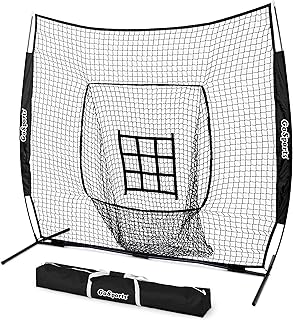
GoSports 7 ft x 7 ft Bow Frame with Strike Zone
The attached strike zone target is what makes this net worth recommending specifically to pitchers rather than general hitters. The fabric target gives a visual cue that keeps throwing sessions focused instead of degenerating into casual toss. The bow-type frame collapses for storage and the carry bag makes transport straightforward.
- Strike zone target transforms batting practice into measurable accuracy work.
- Carry bag and collapsible design make it genuinely portable between a garage and a driveway.
- Bow frames flex noticeably on hard line drives, sending balls sideways instead of containing them.
Skip it if your primary use case is high-velocity hitting. The flex geometry works against containment when exit speeds climb.
7x7FT Portable Pop-Up Frame Net
Pop-up frames are the fastest setup in this category, and this one delivers on that promise without the usual thin-fabric compromise. The large practice area means you get usable width even after the pop-up arches consume some lateral space. Indoor and outdoor versatility makes it practical for apartment residents who cannot commit square footage to a permanent frame in a yard.
- Genuine pop-up deployment in under a minute, which removes the friction that kills practice consistency.
- Light enough to relocate between rooms or take to a park without a vehicle.
- Pop-up geometry cannot match the rigid containment depth of metal-frame nets, so ground balls find gaps more often.
Skip it if you need a net that stands up to a full team rotation. The pop-up mechanism wears faster under daily multi-user stress.
Heavy-Duty Blocking System with Pre-Assembled Metal Frame
This is the one net on the list that addresses the core containment failure most backyard nets suffer from. The blocking system at the base prevents balls from rolling underneath, which is the single most frustrating problem when you are hitting at full speed and chasing baseballs through the neighbor’s fence. The pre-assembled frame eliminates the bolt-together frustration that plagues cheaper metal options.
- Blocking system solves under-net ball leakage, the most common complaint in this category.
- 7-ply tear-resistant fabric handles hard-hit balls that shred thinner nets within a season.
- Heavier than every other option, making relocation impractical once it is set in a yard.
Skip it if storage space is limited or if you plan to move the net frequently. Its permanence is a feature for some and a dealbreaker for others.
GoSports 7 ft x 7 ft Bow Frame with Strike Zone (Value Angle)
The same GoSports bow-frame net earns a second spot here for a different reason: it is the best option for households with multiple users at different skill levels. The carry bag means a parent can move it to the garage when space is needed, and the strike zone keeps a younger player focused on targets while an older sibling works on swing mechanics. The color options mean you can match it to team colors, which sounds trivial until a kid actually cares about it.
- Bow-frame flexibility means it survives rougher handling from younger, less careful users.
- Strike zone and carry bag together create a net that serves both training and casual use.
- Two people hitting simultaneously is not viable because the bow flex creates unpredictable rebound angles.
Skip it if you plan for solo hard-hitting sessions exclusively; the rigid metal frame option contains better.
Steel Frame 7x7ft/8x8ft Net with Carry Bag
At thirty dollars, this is the lowest-friction entry into a proper steel-framed hitting net. No one should expect 7-ply fabric or a blocking system at this price, but the steel frame holds geometry far better than a pop-up arch, and the carry bag means you are not permanently committing a corner of your yard. The 8×8 option adds meaningful width for taller hitters or pitchers needing more lateral margin.
- Thirty dollars for a steel frame with a carry bag is genuinely hard to beat on value.
- Two size options let buyers match footprint to available space without overpaying.
- Fabric and stitching quality reflect the price; expect a useful lifespan of one to two full seasons before replacement is wise.
Skip it if you are hitting with a bat at adult speeds. The frame holds, but the net will develop holes at the contact points within months.
7x7FT Portable Pop-Up Net (Storage-Conscious Angle)
For anyone whose living situation prohibits permanent outdoor equipment, the pop-up design solves the problem no metal frame can. When folded, it fits in a coat closet, a car trunk, or under a bed. This second look at the same net is warranted because the storage profile is genuinely the deciding factor for apartment residents, townhome dwellers with shared yards, and coaches who run multi-station practices with only a small SUV for transport.
- Folded storage is the smallest footprint of any net in this roundup.
- Weight is low enough that a single adult handles setup and teardown without assistance.
- Frequent folding accelerates wear at the fabric-to-frame attachment points, a known pop-up weakness.
Skip it if your space situation is permanent and your hitting is intense; you will outgrow it by mid-season.
PowerNet 7×7 with Accessories (Coaching Station Angle)
Coaches running practice stations benefit from the PowerNet bundle in a way parents do not. The Ball Caddy means one player does not block the others from collecting balls, and the weighted baseballs serve a dual purpose as both training aids and a way to reduce the number of balls needed per station. When you are outfitting three or four hitting stations from one vehicle, the included accessories mean fewer loose items to inventory at the end of practice.
- Ball Caddy reduces ball-retrieval time, which is the hidden bottleneck in group practices.
- Weighted balls add a strength element to swing work without requiring separate equipment.
- At scale, the bundled pricing becomes less attractive than buying nets and accessories separately.
Skip it if you are outfitting more than a handful of stations; bulk pricing on standalone nets and caddies will undercut this bundle quickly.
Buying Guide
Frame Type Determines Everything Downstream
Pop-up frames win on portability and lose on containment. Bow-type frames split the difference, flexing under impact but holding their general shape. Pre-assembled steel frames dominate on ball containment and durability but sacrifice all portability. Choose based on where the net lives, not on how the listing describes the fabric. A mediocre net on a rigid frame outperforms a good net on a bow frame for hard hitters because the geometry directs energy downward rather than laterally.
Net Ply Count and Stitching Quality Are Where Budget Nets Fail
Single-ply or double-ply netting develops holes at the strike zone within weeks of adult-level hitting. The 7-ply options in this roundup represent the threshold for a net that survives a full season of daily use. If the listing does not specify ply count or thread type, assume the worst. Reinforced stitching at the frame attachment points matters more than the net fabric itself; that is where the first failures appear.
Accessories Should Justify Their Cost Against a Standalone Net
Bundles like the PowerNet package make sense when you are starting from zero equipment and value time saved shopping over components that match your quality standards. If you already own a tee or have ball storage handled, strip the bundle mentally and evaluate the net alone. Many bundles net you a mid-tier product at a premium-tier price because the accessories anchor perceived value.
Our Verdict
Our top pick is the Heavy-Duty Blocking System net. It solves the two problems that cause owners to abandon backyard hitting nets: ball leakage and premature fabric failure. It is not the cheapest, and it is not the most portable, but it is the one you buy once and still use three seasons later.
The budget pick is the Steel Frame 7×7/8×8 at thirty dollars. It is the cheapest way to get a rigid frame that holds its shape, and the 8×8 option adds real value for taller players. Treat it as a seasonal consumable and you will get your money’s worth.
If your primary constraint is storage rather than budget, the Pop-Up Portable net wins over both picks above. No amount of frame rigidity matters if the net sits folded in a closet because the yard is shared or too small to accommodate a permanent setup.
FAQ
Can I use a hitting net for softball and baseball interchangeably?
Yes, provided the net mesh is tight enough to contain a softball, which has a larger circumference than a baseball. Most 7×7 nets in this category handle both without issue. The concern is not size but speed; softball underhand pitches and baseball overhand throws stress different regions of the net.
How much space do I actually need behind a hitting net?
You need the net footprint plus a reasonable swing radius in front, and a few feet of clearance on both sides for lateral rebound. Most owners underestimate the swing radius; a hitter needs roughly eight feet of clearance in front of the net just to take a full cut without the follow-through hitting the frame.
Do pop-up nets last as long as metal frames?
Under single-user conditions, a pop-up net will last two to three seasons before the attachment points begin to fray. Metal frames do not degrade the same way, but their net panels can fail if the fabric is low quality. The frame type matters less than whether the net fabric itself is rated for repeated hard impact.
Is a strike zone target actually useful or just a marketing feature?
It is genuinely useful for pitchers and for hitters working on zone recognition, because it externalizes the target and removes the ambiguity of “throw it there.” For a casual backyard hitter with no specific training goal, it is decorative. For anyone preparing for tryouts or working with a coach on pitch selection, the visual target measurably improves session focus.