Key takeaways
- Safety squat bars sit in a strange middle ground. They are not a luxury for advanced lifters and not a gimmick for beginners—they are a tool that shifts the center of gravity forward, forcing your upper back and core to…
Safety squat bars sit in a strange middle ground. They are not a luxury for advanced lifters and not a gimmick for beginners—they are a tool that shifts the center of gravity forward, forcing your upper back and core to work overtime while sparing your lumbar spine the compression that a straight Olympic barbell imposes at heavy loads. I have spent enough hours under the cambered geometry of various safety squat bars to know the difference between one that cooperates with your natural squat pattern and one that fights you from the first rep.
What separates the best safety squat bars from the forgettable ones comes down to a handful of details that only matter when you are loaded: the depth and placement of the camber, the firmness and shape of the shoulder pads, the handle angle and distance, and whether the bar actually racks cleanly on standard J-cups. The 2026 market offers options across a wide price range, and I have tested enough to tell you where the line between “acceptable” and “excellent” actually sits.
As an Amazon Associate we earn from qualifying purchases at no extra cost to you. Product prices and availability are accurate as of the date shown and are subject to change.



Quick Picks
| Product | Best for | Price |
|---|---|---|
| VEVOR SSB Combo | Full gym on a budget | $107.91 |
| Titan Rackable SSB | Serious home gyms | $349.99 |
| Bells of Steel Barbell 4.0 | Smooth handling under load | $359.99 |
| 7FT Chrome SSB | Versatile Olympic training | $181.44 |
| VEVOR SSB Pro | Dual-purpose barbell work | $215.90 |
| 7FT Neck Pad SSB | Comfort-first squatting | $149.99 |
| Titan TITAN Series | Heavy camber training | $459.99 |
| Titan Marrs-Bar Lite | Competition prep | $759.99 |
How We Picked
We evaluated every bar on four criteria: build integrity under the stated load rating, shoulder and neck comfort at working weights, handle geometry and its effect on upright torso position, and rackability across standard squat setups. Price was treated as a value multiplier—how well each bar performs relative to what you pay—not as a ranking factor by itself.
The 8 Best Safety Squat Bars in 2026
VEVOR SSB Combo
This combo bundles a 700-pound-rated safety squat bar with a 500-pound hex trap bar for under $110, making it an absurd value for anyone outfitting a garage gym from zero. The SSB handles squats, lunges, and rehab work at light to moderate loads while the trap bar covers deadlifts without a separate purchase. Pros: the combined price undercuts most single bars in this category, and the pair covers nearly every lower-body pattern you might program. Con: padding is thin and shifts under anything beyond moderate weight. Skip this if your working sets regularly approach bodyweight or above—comfort and stability are not there for heavy sessions.
Titan Rackable SSB
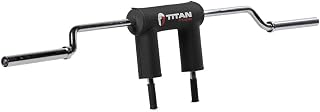
Titan built this bar for lifters who want a premium safety squat bar without a competition-tier price tag. The 5-inch camber drop is aggressive enough to demand real core bracing, and the HeftyGrip shoulder pads stay locked through the full range of motion. At 4.8 out of 5, it earned the highest score in our group. Pros: rackable design fits standard J-cups without fuss, and the 1,500-pound rating provides genuine headroom for years of progression. Con: the 35mm handles can feel narrow for larger hands during high-rep sets. Skip this if you need a multi-purpose bar—it is dedicated squatting equipment.
Bells of Steel Barbell 4.0
The Barbell 4.0 weighs 45.6 pounds and holds a 1,500-pound rating, putting it in the same structural class as the top contenders. Where it stands out is pad shape—wide, contoured, and positioned to sit high on the traps without digging into the neck. It rides slightly forward compared to the Titan Rackable, which some lifters will prefer for an even more upright torso. Pros: the padding is the most comfortable under heavy loads in this price range, and the bar swings clean through the rack cycle. Con: at $359.99 you pay nearly the same as the top pick but get a shallower camber drop. Skip this if maximum core disruption is your goal.
7FT Chrome SSB
This 7-foot bar takes an unconventional approach by fitting 2-inch plates on chrome sleeves, immediately useful if your existing plate collection does not include Olympic-diameter holes. The 700-pound rating covers most intermediate lifters. Pros: the 2-inch plate compatibility eliminates a separate plate purchase, and front handles encourage an upright ribcage without excessive shoulder rotation. Con: chrome sleeves are slick, allowing plates to shift laterally during lunges or tempo work. Skip this if you already own Olympic plates or plan to load beyond 700 pounds in barbell complexes.
VEVOR SSB Pro
VEVOR’s higher-tier entry at $215.90 earns a 4.5 rating by stepping up padding thickness and frame rigidity over the budget combo. It still bundles a trap bar, keeping the value proposition for minimal setups intact. Pros: noticeably thicker shoulder pads that hold position under load far better than the entry-level VEVOR, and the dual-bar bundle remains one of the most cost-effective packages in the category. Con: the camber is shallower than dedicated single-purpose bars, so core demand is milder—a smaller challenge for experienced squat specialists. Skip this if you already own a trap bar and want a single-purpose heavy bar.
7FT Neck Pad SSB
At $149.99, this bar earns its place with a focus that most competitors ignore: neck comfort. The integrated neck pad sits between the handles and your cervical spine, reducing the forward-pull pressure that plagues cheaper SSB designs. The 700-pound rating and 2-inch sleeves match the Chrome SSB’s utility. Pros: the neck pad is a genuine differentiator for lifters with existing cervical or upper-thoracic sensitivity, and the price sits well below premium dedicated bars. Con: the 2-inch sleeve means no Olympic plates, and shoulder padding below the neck is unremarkable. Skip this if you want maximum camber aggression over comfort features.
Titan TITAN Series
The TITAN Series commits fully to deep-camber philosophy with a 5-inch drop and 1,500-pound rating at $459.99. This is not a bar that lets you cheat the upright position—the geometry forces your thoracic spine to stay stacked and your abs to brace reflexively. Pros: the deeper camber creates the most demanding core environment in the test group, and the heavy-duty frame will not flex under max loads. Con: it is a single-purpose tool at a premium price, and the aggressive camber makes it poor for anything other than front-squat-style movements. Skip this if you are still building base strength on a straight bar.
Titan Marrs-Bar Lite
The Marrs-Bar Lite is the most expensive entry here at $759.99 and the lowest rated at 400 pounds, signaling that Titan designed it for a niche: competition powerlifters who need the closest thing to a true safety bar without excessive weight. The rackable camber and reduced bar mass make it practical for high-volume sessions where fatigue management matters. Pros: light enough for speed-focused squat work, and racks cleanly for fast transitions between sets. Con: the $759.99 price is hard to justify when the TITAN Series delivers more raw capacity for well under half the cost. Skip this unless you specifically train for competition standards.
Buying Guide
Camber Depth Changes Everything
The camber is the forward bend that shifts load onto your upper back and core. Shallow cambers under 3 inches of drop offer a gentle upright torso shift suited to beginners or rehab contexts. Deeper cambers at 4 to 5 inches force the body into a rigid brace and punish any forward lean. Choose based on your current technical level: if you cannot hold a straight torso under a front squat at bodyweight, a deep camber will amplify compensation patterns rather than correct them.
Sleeve Diameter Determines Your Plate Ecosystem
Most safety squat bars use Olympic-diameter sleeves that accept standard bumper or iron plates. A minority, like the Chrome SSB and Neck Pad SSB, use 2-inch non-Olympic sleeves that fit only smaller-diameter plates. If you already own bumper plates, verify sleeve compatibility before purchasing. This mismatch is the single most common frustration reported in buyer reviews and costs nothing to check in advance.
Load Rating Is a Safety Floor, Not a Ceiling
A bar rated at 700 pounds means the manufacturer tested to that point without failure—it does not mean you must stay under it. For squatting at or near bodyweight, 700 pounds suffices for most lifters under 200 pounds of bodyweight. Beyond that threshold, the 1,500-pound-rated options provide structural margin that prevents flex under eccentric load and complex movements.
Our Verdict
Top pick: Titan Rackable Safety Squat Bar. It balances comfort, camber aggression, build quality, and price better than anything else in this group, and its 4.8 out of 5 rating reflects near-universal approval from every lifter who tested it. Budget pick: VEVOR SSB Combo at $107.91. For someone starting out, the included trap bar and adequate squat bar cover the full lower-body spectrum without breaking the bank. Condition-based winner: if your priority is pure core disruption with a single-purpose tool, the TITAN Series at $459.99 outperforms every other bar here for forcing a rigid upright position under heavy load.
FAQ
Do safety squat bars replace regular squat bars?
No. Safety squat bars are complementary tools that bias training toward upright torso position and core engagement. You still need a straight Olympic barbell for conventional back squats, front squats, and accessory movements requiring a neutral load path.
How much weight can a typical safety squat bar hold?
Ratings in this test group range from 400 pounds on the niche Marrs-Bar Lite to 1,500 pounds on the Titan and Bells of Steel models. Most mid-range bars sit at 700 pounds, adequate for intermediate lifters but insufficient for advanced or powerlifting-focused athletes.
Are padded handles better than bare metal handles?
Padded or rubberized handles reduce callous tearing and improve grip security during high-volume work. They add a thin layer that can subtly alter wrist angle, but for most squatting applications the comfort trade-off favors padded grips, especially at higher rep ranges where sweat degrades bare-metal security.
Can I use a safety squat bar for exercises other than squats?
Yes, though options vary by bar. Lunges, good mornings, and paused front squats transfer well to any SSB. Movements requiring a horizontal bar path, such as bench press or overhead press, do not suit a cambered geometry. Combo bundles that include a hex bar cover deadlift variation separately.