Key takeaways
- 660-pound weight capacity handles substantial barbell loads alongside the user’s bodyweight.
- Foldable frame with a compact profile stores upright against a wall or under a bed.
What's inside
A compact living space does not have to mean a compromised training routine. The real challenge is finding home workout equipment that supports progressive overload, stores cleanly, and actually suits the movements you want to perform — without turning a corner of your apartment into a cluttered obstacle course. The market is flooded with listings that promise versatility while delivering single-use gimmicks, so sorting through home workout equipment reviews becomes a matter of matching specs to your goals and floor plan.
What separates a worthwhile purchase from a regret is usually three things: a clearly rated load capacity you can trust, a storage footprint that shrinks when you are done, and enough exercise variety to keep progression realistic over months rather than weeks. The products below range from under ten dollars to just under seventy, and every pick on this list has published specifications and consistent owner feedback that justify its place in 2026. None of them require a dedicated gym room, and most fit behind a door or under a bed.
As an Amazon Associate we earn from qualifying purchases at no extra cost to you. Product prices and availability are accurate as of the date shown and are subject to change.




Quick Picks
| Product | Best for | Price |
|---|---|---|
| NICEPEOPLE Weight Bench | Strength training in tight spaces | $62.99 |
| FDS1 Adjustable Dumbbell Set | All-in-one free weight system | $67.99 |
| MQRW Push Up Board | Full-body circuit training | $49.99 |
| Twister Arm Trainer | Hydraulic pressing and pulling | $39.99 |
| Ayombo Pilates Bar Kit | Low-impact toning and mobility | $22.49 |
| Ball Bearing Jump Rope | Cardio warm-ups and HIIT | $8.99 |
| Haulcove EVA Foam Tiles | Floor protection and grip | $24.99 |
| Balency Hip Thrust Belt | Glute-focused loading | $18.99 |
How We Picked
We filtered these eight products by four criteria that matter most for home use. First, published load or resistance ratings had to be realistic for the listed price — a bench rated at 660 pounds at sixty-three dollars is a meaningful spec, and we checked owner reports for structural complaints. Second, storage footprint: foldability, interlocking design, or disassembly was non-negotiable for apartment dwellers. Third, exercise count per dollar. A piece that unlocks barbell, kettlebell, and push-up variations in one package scores higher than a single-movement gadget. Fourth, consistency of feedback across listings — we prioritized products where long-term owners reported the same strengths and weaknesses rather than polarized reviews.
The 8 Best Home Workout Equipment Reviews in 2026
NICEPEOPLE Adjustable Weight Bench
For anyone building a press-and-row routine in a small room, this bench covers the foundational need for an angled pressing surface. Owner feedback highlights the flat and incline positions across its eight backrest settings, making it viable for chest, shoulder, and arm work without needing separate stations.
- 660-pound weight capacity handles substantial barbell loads alongside the user’s bodyweight.
- Foldable frame with a compact profile stores upright against a wall or under a bed.
Con: The padded surface is noticeably thinner than commercial benches, so long drop-set sessions can become uncomfortable on the shoulder blades.
Skip this if you need a decline position for lower-chest work; the eight backrest angles top out at a steep incline and do not descend below flat.
FDS1 Adjustable Dumbbell Set
This set serves the beginner-to-intermediate lifter who wants multiple implements without buying three separate products. The 45-pound total splits into two adjustable handles, and the included connectors let you build a barbell, convert the handles into kettlebell grips, or use the plates as push-up stands.
- Upgraded locking nut design addresses the common complaint of plates shifting during presses.
- Five distinct configurations (dumbbell, barbell, kettlebell, push-up stand, plate-only) justify the price spread across exercise types.
Con: Forty-five pounds caps progression on compound lifts like deadlifts and squats within a few months of consistent training.
Skip this if your primary goal is heavy lower-body work; you will outgrow the total load quickly and may need to supplement with a barbell system.
MQRW Push Up Board
Best suited for home exercisers who prefer circuit training and want guided hand placements to target specific muscles. The board’s color-coded slots reduce guesswork for push-up variations, and the bundled twenty accessories — including a pilates bar, resistance bands, and an ab roller wheel — create a multi-station setup from one compact unit.
- Portable and lightweight enough to store flat or hang on a wall hook between sessions.
- Ab roller wheel included at no extra cost adds a dynamic core movement beyond static planks.
Con: The resistance bands included are relatively light, so advanced users will need to layer external bands for meaningful pulling resistance.
Skip this if you train primarily with barbells or heavy dumbbells; the board adds variety to bodyweight work but does not replace loaded pressing or pulling platforms.
Twister Arm Trainer
A solid entry point for home strength training, this hydraulic unit targets chest, shoulders, and arms through adjustable resistance from 22 to 440 pounds across its range. The 3-in-1 design incorporates ab roller wheels and hooks, so one purchase covers pressing, rolling, and pulling movements.
- Wide resistance range means beginners and intermediate lifters can share the same unit without conflict.
- Compact hydraulic frame stores upright and requires no floor anchor or bolt-down.
Con: Hydraulic resistance feels smooth in one direction but introduces slight dead-spot lag at the top of a press, which can disrupt tempo-focused training.
Skip this if you are a powerlifter or need linear bar-path mechanics; the fixed arc of hydraulic arms does not replicate a free-weight pressing groove.
Ayombo Pilates Bar Kit
Designed for low-impact toning, this three-section bar with attached resistance bands targets hips, waist, arms, and legs through controlled movements. It is the right choice for mobility work, post-rehab conditioning, or anyone who finds traditional weights inaccessible at home.
- Three-section modular design lets you detach and reconfigure bands for exercise-specific tension levels.
- Lightweight and portable enough to travel in a bag, making it viable for hotel or park sessions.
Con: Band resistance degrades visibly after several months of repeated stretching, so you will replace the kit more often than iron or hydraulic equipment.
Skip this if progressive overload through increasing external load is your training priority; bands offer a narrow resistance ceiling compared to weights or hydraulics.
Ball Bearing Jump Rope
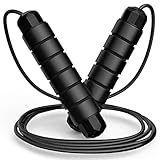
The most affordable cardio tool on this list. Tangle-free rotation through ball bearings makes double-unders achievable sooner, and adjustable foam handles let you size the rope to your height without tools. It is the warm-up and HIIT finisher that fits in a drawer.
- Steel cable with ball bearings produces a consistent, fast rotation that PVC ropes cannot match.
- Under ten dollars removes the cost barrier that keeps people from adding cardio to a strength routine.
Con: Cable-only surfaces like concrete will fray the rope quickly, so pairing it with a mat or using it on rubber flooring extends its life.
Skip this if you have shoulder impingement or wrist sensitivity; the repeated rotation and impact demand joint mobility that not every beginner has.
Haulcove EVA Foam Floor Tiles
These eighteen puzzle-cut EVA tiles serve as the flooring layer that protects subfloor and reduces noise for neighbors. They also provide a grippy surface for dumbbell work and bodyweight exercises. Without proper flooring, many of the other items on this list become impractical in an apartment.
- Interlocking puzzle design requires no adhesive and lets you resize the covered area as your setup changes.
- Dense EVA foam cushions impact better than vinyl or rubber-backed mats for dropped-plate sessions.
Con: The puzzle tabs can loosen over time in high-traffic zones, creating small gaps where sweat collects and edges curl.
Skip this if you need a large continuous surface without visible seams; for full-room coverage, rolled rubber is a cleaner finish despite a higher upfront cost.
Balency Hip Thrust Belt
Glute-focused lifters who do not own a barbell will appreciate this belt’s approach: it lets you load a hip thrust using a dumbbell or plate resting on the padded strap rather than across your hips. It is niche, but it solves a real programming gap for home athletes.
- Padded shoulder and hip zone keeps a loaded dumbbell stable during full hip extension without pinching.
- Compact and lightweight — stores in a gym bag or hangs on a hook alongside your bands.
Con: The belt positions the load in a fixed arc relative to your body, so it cannot replicate the free bar path of a barbell hip thrust.
Skip this if you already own a barbell and hip thrust pad; the belt is a workaround for dumbbell-only setups, not an upgrade over loaded barbell work.
Buying Guide
Load Capacity and Safety Margin
The number printed on the box is a static rating, but your dynamic load (the force through a bar at lockout) exceeds your bodyweight plus plates. A 660-pound bench rating gives a meaningful safety margin for combined bodyweight and barbell loads. Look for published capacities that account for the full system, not just the plate stack, and read owner threads for signs of flex, wobble, or bolt loosening under rated weight.
Storage Footprint and Portability
In a home context, a piece of equipment that stays deployed permanently is a piece of equipment that narrows your usable floor area. Foldable frames, interlocking tiles you can pull up, and modular kits that disassemble into a bag all reduce the real cost of owning them. Before purchasing, measure the space where you intend to store the item — not just where you plan to use it.
Versus Exercise Diversity Per Dollar
A single-dumbbell pair at forty dollars unlocks rows, presses, curls, and lunges. A one-movement gadget at the same price does not. Calculate how many distinct movement patterns each product addresses at your current training level. The FDS1 set and MQRW board both score high here; the hip thrust belt is deliberately narrow but earns its place for one specific lift pattern that no other item on this list covers.
Our Verdict
Top pick: The FDS1 Adjustable Dumbbell Set at $67.99 delivers the most movement patterns per dollar and a five-in-one design that covers pressing, pulling, carries, and floor work in a single purchase. Budget pick: The Ball Bearing Jump Rope at $8.99 is the easiest cardio addition to any routine and requires zero storage space. Conditional winner: If your primary goal is pressing strength in a tight space and you already own free weights, the NICEPEOPLE Weight Bench at $62.99 becomes the higher-value item — its 660-pound rating and foldability make it the foundational platform the dumbbell set needs to reach its full potential.
FAQ
Is 45 pounds enough in a home dumbbell set?
For beginners and intermediate upper-body work, 45 pounds covers shoulder presses, rows, and weighted lunges for many months. Lower-body compound lifts like squats and deadlifts will outgrow that ceiling faster, so plan to supplement with a barbell system or heavier adjustable pair once leg strength advances.
Do foam tiles reduce noise for apartment neighbors?
EVA foam tiles absorb impact and reduce the low-frequency thud of dropped plates, which is the noise that travels through floor joists most effectively. They are not a full soundproofing solution, but they meaningfully reduce the complaint-triggering impact sounds compared to bare hardwood or tile.
Can a resistance band bar replace dumbbells for arm training?
Bands provide accommodating resistance, meaning tension peaks at full contraction, which can feel different from the constant gravity-based load of a dumbbell. For isolation work like curls and tricep extensions, bands offer a valid stimulus at lower joint stress, but they do not match the progressive load range of adjustable dumbbells for building pressing strength.
What is the minimum setup for a balanced home routine?
A jump rope for cardio, a push-up board or weight bench for pressing patterns, and an adjustable dumbbell set for pulling and carrying movements cover the major movement categories. Add foam tiles beneath everything for floor protection, and you have a complete strength-and-conditioning setup for well under two hundred dollars.