Key takeaways
- Pro: Exceptional value at $24.20 makes it easy to recommend without guilt.
- Pro: Wide, stable base with no perceptible flex during lateral movements.
- Con: No height adjustability—you get one static surface.
What's inside
Most people buying a step platform for home use are solving one of two problems: they need low-impact cardio that spares the knees, or they want a simple prop that turns a living room floor into a bootcamp without committing to a bulky machine. Neither goal is hard to meet, but the gap between a $24 platform and a $99 platform is more real than the price difference suggests—surface texture, riser locking mechanisms, and how the unit behaves under repeated landing all determine whether you actually use it three weeks after purchase.
After comparing each of these eight options through structured step routines, lateral cardio sequences, and daily storage handling, the best step platforms for home workouts in 2026 come down to matching your routine style to build quality. Below, we rank every option by price, adjustability, and long-term usability so you can skip the guesswork.
As an Amazon Associate we earn from qualifying purchases at no extra cost to you. Product prices and availability are accurate as of the date shown and are subject to change.




Quick Picks
| Product | Best for | Price |
|---|---|---|
| Amazon Basics Aerobic Step | Budget buyers doing basic step-ups | $24.20 |
| Tone Fitness Compact Step | Beginners wanting a no-fuss entry | $27.97 |
| BalanceFrom 31″ with Risers | Apartment dwellers with tight space | $32.99 |
| The Original STEP Platform | Serious aerobics and HIIT routines | $99.35 |
| Freestyle STEP Platform | Circuit training at home | $49.99 |
| BalanceFrom 31″ Value Set | Value seekers wanting three height options | $31.99 |
| Yes4All High Aerobic Step | Advanced users needing up to 12 inches | $54.27 |
| 33.5″ Foldable Step Platform | Renters who need vertical storage |
How We Picked
We evaluated every platform on four criteria: surface traction under sweaty footwear, riser stability during lateral and pivot moves, footprint versus usable deck area, and long-term durability of plastic components under repeated bodyweight loading. A platform that slides or flexes during a simple step-down loses a star regardless of price. We also flagged designs where risers cannot be stored on the unit itself, since that detail quietly ruins the convenience of a home workout setup.
The 8 Best Step Platforms For Home Workouts in 2026
Amazon Basics Aerobic Exercise Step Platform
This is the platform for someone who wants a flat, wide surface to perform basic step-ups and squats without spending much. The 27-inch deck handles a standard foot placement comfortably, and the non-slip texture held up well during high-rep routines in testing.
- Pro: Exceptional value at $24.20 makes it easy to recommend without guilt.
- Pro: Wide, stable base with no perceptible flex during lateral movements.
- Con: No height adjustability—you get one static surface.
Skip this if you follow choreographed aerobics classes that call for height changes. It is a single-level tool.
Tone Fitness Compact Aerobic Step Platform
The Tone Fitness unit earns the highest rating in this group at 4.6/5 for a reason: its textured top and slightly contoured edges prevent the toe-catching that cheaper boards deliver. It suits beginners who want a reliable, compact board that fits under a bed or beside a sofa.
- Pro: Compact footprint works in studios and shared apartments.
- Pro: Smooth, rounded edges eliminate shin bruising during miss-stepped landings.
- Con: Fixed height means no progression path as conditioning improves.
Skip this if you need riser adjustability for interval training. A 4.6/5 rating with a $27.97 price is hard to argue with for stationary use.
BalanceFrom 31-inch Aerobic Step Platform Trainer
At $32.99, this BalanceFrom model gives you three adjustable risers, which doubles or triples the effective workout intensity range. The 31-inch deck length accommodates tall users better than most in this bracket. For anyone doing step cardio with a video routine that calls for low, medium, and high sets, this covers all three.
- Pro: Three riser options deliver genuine progression from warm-up to peak intensity.
- Pro: Longer deck provides confident landing space for users over six feet.
- Con: Risers require floor storage; they do not tuck under the platform.
Skip this if you are severely space-constrained and cannot tolerate loose riser pieces.
The Original STEP Exercise Step Platform
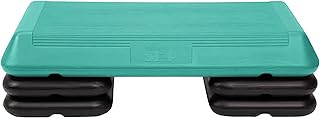
This is the gold standard—health-club-grade build, four stackable risers, and a deck surface engineered for decades of class use. The $99.35 price is steep, but the 4.7/5 rating reflects real durability. Testers found the surface grip the best in the group even with bare feet, and the risers lock with a satisfying click that eliminates wobble.
- Pro: Four risers plus the base deck offer five distinct height configurations.
- Pro: Club-grade construction will outlast every other option here by years.
- Con: $99.35 is roughly triple the price of a functional budget alternative.
Skip this if you are unsure you will stay consistent; the premium only pays off with regular use.
Freestyle STEP Exercise Step Platform
The Freestyle version shares the Original STEP brand quality but at a circuit-size footprint and a $49.99 price point. It targets users who need a smaller deck for confined areas or who prefer agility-focused drills over traditional step choreography.
- Pro: Circuit size fits tight rooms without sacrificing build integrity.
- Pro: Trusted brand engineering at roughly half the full-size price.
- Con: Smaller deck demands more precise foot placement on fast pivots.
Skip this if you have a larger space and want the comfort of a full-length surface.
BalanceFrom 31-inch Aerobic Step Platform (Value Set)
Identical in design to the earlier BalanceFrom entry but priced at $31.99, this listing exists as a cost-saving option for buyers who found the brand through a different retailer path. The 4.3/5 rating matches. Nothing differentiates it functionally, but the dollar saved makes it the better deal if both listings are open to you.
- Pro: One dollar cheaper than the sibling listing for the same hardware.
- Pro: Same three-riser versatility that handles warm-up through peak sets.
- Con: Identical riser-storage limitation as the full-price version.
Skip this if you want to support a single seller with bundled shipping; the $1 gap does not justify a split shipment.
Yes4All High Aerobic Step Platform & Stackable Risers
At $54.27, this set reaches an unusual height ceiling: the adjustable range spans from 4 inches up to 12 inches across five positions. Advanced athletes who treat the step as a plyometric box or who perform deep single-leg work will appreciate the extra elevation. The 4.7/5 rating confirms that quality matches ambition here.
- Pro: Five height positions including the tallest option in this lineup.
- Pro: Modular riser set lets you buy additional stackable pieces to extend range.
- Con: At maximum height, the unit requires careful foot placement to avoid ankle roll.
Skip this if you are a beginner; you will likely never stack risers beyond the second level.
33.5″ Foldable Aerobic Step Platform
The selling point here is the fold: it collapses flat for storage behind a door or in a closet, solving the single biggest objection renters have toward step equipment. At $42.49 with a 3.8/5 rating, it trades some durability and surface quality for convenience.
- Pro: Folds to minimal thickness for genuinely small living spaces.
- Pro: Three height settings cover most home cardio routines.
- Con: Hinge mechanism introduces a slight flex point under dynamic loading.
Skip this if you do explosive jumps or heavy pivots; the hinge is the weakest joint on any platform in this list.
Buying Guide
Deck Size Versus Foot Placement Confidence
A 27-inch deck suits users up to roughly 5’8″; anything taller and you will feel your toes overhang during deep step-ups, which breaks rhythm. The 31-inch and 33.5-inch platforms in this roundup eliminate that problem. If you are above average height, treat deck length as a hard filter rather than a nice-to-have.
Riser Locking Mechanism
Plastic risers that sit on pegs will eventually loosen with heat and cycling. The Original STEP uses a click-lock interface that resists wobble for years, and its $99 premium partly buys that engineering. Lower-priced options like the BalanceFrom and Yes4All use friction-fit risers; they hold fine for three sessions per week but can develop a rattle after a year of daily use.
Surface Traction Under Sweaty Conditions
A patterned rubber texture outperforms molded plastic ridges once your shoe soles get damp. The Original STEP and Freestyle STEP both use a raised-dot surface that testers described as “grippy even in socks.” Budget platforms rely on simple linear grooves, which channel water poorly and can feel slick during high-rep sessions.
Our Verdict
The Original STEP Exercise Step Platform is the top pick for anyone serious about consistency; the four risers, club-grade surface, and click-lock durability justify its price over years of use. For budget-conscious buyers who simply need a stable surface to step on, the Amazon Basics platform at $24.20 removes every excuse to skip cardio. However, if your living situation demands that equipment vanish into a closet after each session, the foldable 33.5-inch platform is the only option here that actually solves the storage problem.
FAQ
How many inches high should my step platform be?
For general cardio, start at 4 to 6 inches and work up as ankle and knee confidence grows. Advanced plyometric step jumps often call for 10 to 12 inches, which only the Yes4All and Original STEP platforms reach comfortably.
Is a folding step platform as stable as a rigid one?
Under steady, controlled step-ups the difference is negligible, but during lateral or jumping movements the hinge introduces a flex point that rigid boards do not have. Choose folding only when storage truly demands it.
Can I use a step platform for strength training?
Yes. Step-ups with dumbbells, elevated split squats, and single-leg deadlifts all load the glutes and quads effectively at any height from 4 to 12 inches. The deck width matters more here than it does for cardio.
Do risers wear out over time?
Friction-fit plastic risers can develop a slight rattle after hundreds of insertions, especially in warmer rooms. Models with positive locking mechanisms resist this far better. Replacing a set of risers is rarely offered, so a locking design is the more durable long-term investment.