Key takeaways
- After each cook: scrape while warm, remove loose debris, and empty grease channels or trays.
- Cast iron: wipe clean, dry completely, and apply a very thin oil film. Avoid long soaking.
- Stainless steel: use a nylon brush or a suitable stainless-safe pad; avoid carbon-steel brushes that can leave contaminating bristles.
- Coated aluminum: use non-abrasive tools and mild detergent only when the product instructions permit it.
- Seasonally: inspect for cracked welds, loose supports, deep pitting, flaking coating, and warping that prevents stable seating.
Best Searing Grates for High-Heat Cooking
The best searing grates for high-heat cooking are usually thick cast iron for maximum heat retention, stainless steel for easier maintenance and broad grill compatibility, or raised-channel panels such as GrillGrate-style systems when you want concentrated sear marks with less flare-up.
Quick picks by cooking situation
| Situation | Best grate type | Why it fits | Typical 2026 market range |
|---|---|---|---|
| Maximum steak sear | Thick cast iron | Highest heat retention and strong browning | $35–$100 |
| Frequent high-heat use with simple cleanup | Heavy stainless steel | Resists rust and tolerates repeated heating | $45–$130 |
| Gas grill with flare-up concerns | Raised-channel aluminum panels | Creates defined marks while shielding food from direct flame | $50–$120 |
| Portable or compact grill | Single cast-iron or stainless insert | Uses less space and is easier to store | $25–$70 |
| Mixed cooking for vegetables and delicate foods | Stainless grate with narrow, rounded bars | More forgiving than an aggressive steak-only grate | $40–$110 |
What makes a searing grate effective?
A searing grate does not create browning simply because it reaches a high advertised temperature. Performance depends on the metal’s thermal mass, the width and shape of its contact surface, how closely it fits the heat source, and how quickly it recovers after food is placed on it.
Our top picks


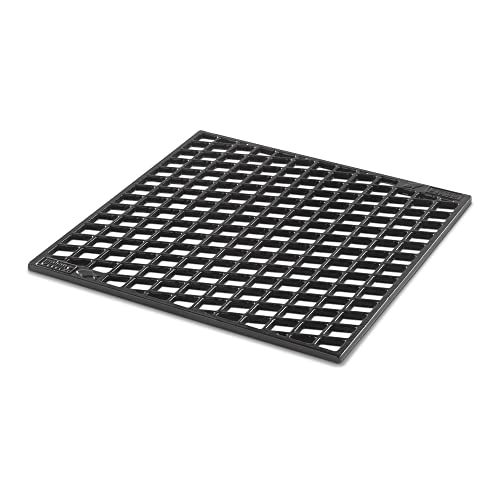

As an Amazon Associate we earn from qualifying purchases at no extra cost to you. Ratings are shown as listed on Amazon.
For most home grills, a grate with bars or ridges approximately 6–10 mm wide gives a useful balance: enough contact area for browning without making the food stick to a broad flat plate. Wider ridges produce heavier marks but can leave more of the food surface untouched. Narrower bars give lighter marks and allow more heat circulation.
Cast iron: the heat-retention specialist
Cast iron is the traditional choice when the priority is a dark crust and strong recovery after adding cold food. A grate or insert weighing roughly 4–8 kg can store considerably more heat than a thin replacement grate. That mass helps prevent the cooking surface from cooling sharply when two thick steaks are added at once.
The trade-off is maintenance. Uncoated cast iron needs to be dried promptly and wiped with a very thin film of cooking oil. It can rust if stored damp, and thermal shock can damage enamel coatings or contribute to cracking in poorly handled cookware. Do not quench a hot cast-iron grate with water.
Stainless steel: the practical all-rounder
Heavy stainless-steel grates are the better choice for owners who value corrosion resistance and low-maintenance ownership. They heat quickly, tolerate high temperatures, and can remain outdoors more safely than bare cast iron, although grease and weather can still cause staining or pitting over time.
Stainless steel usually has less thermal mass than a similarly sized cast-iron grate, so recovery depends more on burner output and preheating. Look for bars around 8–10 mm in diameter or a robust welded grid rather than very thin wire. Thin stainless wire may be inexpensive, but it can distort after repeated high-temperature cycles.
Raised-channel aluminum panels: controlled searing
Raised-channel panels made from anodized or cast aluminum are designed to concentrate heat at ridges while allowing rendered fat to drain into channels. Many include perforations or gaps that reduce direct flare-ups. They can produce pronounced, attractive marks and are often lighter than cast iron.
Aluminum heats and cools quickly, so it does not deliver the same heat reserve as a heavy iron grate. It is also more vulnerable to warping if overheated empty or exposed to sudden temperature changes. Follow the manufacturer’s temperature limits, and avoid abrasive tools that can damage the surface treatment.
Head-to-head comparison
| Characteristic | Cast iron | Stainless steel | Aluminum channel panel |
|---|---|---|---|
| Typical thickness | 8–15 mm | 6–12 mm bars or grid | 3–8 mm panel body |
| Typical weight for 45 × 30 cm | 4–7 kg | 2.5–5 kg | 1.5–3 kg |
| Heat retention | Excellent | Good to excellent | Moderate |
| Rust resistance | Low unless maintained | High | High, but coating can wear |
| Heat recovery | Excellent once fully preheated | Good | Fast heating, faster cooling |
| Best use | Steaks, chops, burgers | Mixed high-heat cooking | Steaks with reduced flare-up exposure |
Check compatibility before buying
Measure the actual cooking surface, not just the grill’s advertised width. A replacement grate needs enough clearance to sit on its supports without touching the lid, burners, heat shields, or rotisserie components. Leave room for expansion: metal length can change by several millimeters as the grate moves from room temperature to high heat.
For a rectangular grill, measure the support-to-support width and depth at three points because cooking boxes are not always perfectly square. A grate that is 1 cm too large in either direction may rock, prevent the lid from closing, or sit directly over burner ports. Also check whether the grill uses a proprietary hinged grate, a circular insert, or a modular system. A universal rectangle is not automatically compatible with a shaped cooking chamber.
A simple coverage calculation
Suppose your grill has 2,400 square centimeters of cooking area and you buy a 45 × 30 cm searing insert. The insert covers 1,350 square centimeters:
45 × 30 = 1,350 cm²; 1,350 ÷ 2,400 = 0.5625.
That insert covers about 56% of the main grate, leaving room for indirect cooking or a cooler holding zone. For a small grill, a half-width insert is often more useful than a full replacement because it lets you sear and finish food at different temperatures without moving everything to a second appliance.
How to get better marks without burning the outside
- Install the grate securely and remove heavy grease buildup from previous cooks.
- Preheat with the lid closed for about 10–15 minutes, then confirm that the grate is fully hot rather than relying only on the lid thermometer.
- Dry the food surface thoroughly. Surface moisture must evaporate before browning begins.
- Oil the food lightly instead of flooding the grate. Excess oil increases smoke and flare-ups.
- Place food across the bars or ridges and avoid moving it until a crust has formed.
- For thick food, sear over the hottest section, then finish over lower or indirect heat.
- Allow the grate to recover between batches. Adding several cold steaks at once can overwhelm a lightweight insert.
Deep marks are not necessarily better searing. If the grate contacts only a small fraction of the food, it may create dark stripes while leaving much of the surface pale. For an evenly browned crust, a plancha or flat griddle is more effective than a ridged grate.
Cleaning and durability under repeated high heat
The parts that usually wear first are thin welded bars, porcelain or enamel finishes, seasoning layers on cast iron, and any fasteners exposed to grease and weather. Repeated heating and cooling can gradually distort lightweight metal. A robust grate should feel rigid when lifted and should not flex noticeably across its longest span.
- After each cook: scrape while warm, remove loose debris, and empty grease channels or trays.
- Cast iron: wipe clean, dry completely, and apply a very thin oil film. Avoid long soaking.
- Stainless steel: use a nylon brush or a suitable stainless-safe pad; avoid carbon-steel brushes that can leave contaminating bristles.
- Coated aluminum: use non-abrasive tools and mild detergent only when the product instructions permit it.
- Seasonally: inspect for cracked welds, loose supports, deep pitting, flaking coating, and warping that prevents stable seating.
Never burn a grate empty for an unnecessarily long period as a cleaning shortcut. A brief high-heat burn can loosen residue, but prolonged empty heating accelerates oxidation, stresses coatings, and can warp thin panels. Replace a grate when it has structural cracks, sharp flaking, or enough distortion to rock on its supports.
Final buying recommendation
Choose thick cast iron if maximum heat retention and steak crust matter more than weight and maintenance. Choose heavy stainless steel if the grate will live outdoors, see frequent use, or cook a wide range of foods. Choose a raised-channel aluminum panel when flare-up control, lighter weight, and defined marks are the priority. In every case, prioritize a rigid, correctly sized grate with enough thermal mass for your batch size; material alone cannot compensate for poor fit or insufficient preheating.