Key takeaways
- Buying by color alone. Yellow, red, green, blue, and black do not mean the same resistance across brands. Read the pound range and dimensions.
- Choosing one “all-purpose” level. Your shoulders, back, legs, and hips have different strength levels. A set provides safer progression.
- Ignoring the band’s starting length. Short mini loops are excellent around the thighs but cannot replace a long band for rows or presses.
- Stretching a band too far. Resistance rises rapidly near maximum extension. Stay within the manufacturer’s stated stretch limit.
- Using too-heavy bands for small-muscle work. Heavy bands can pull the shoulder forward or encourage momentum during rotator cuff and arm exercises.
- Anchoring to unstable furniture. A chair, table leg, or loose bed frame can move unexpectedly. Use a closed door with a proper anchor or a fixed exercise structure.
What's inside
The Short Answer
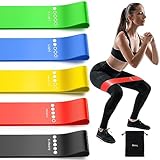
For most people, the best answer to “what resistance band strength do I need” is: start with a set rather than one band. Resistance bands do not have a universal weight rating, and the resistance rises as the band stretches. A light band from one brand can feel similar to a medium band from another, especially with loop bands and fabric hip bands.
If you are new to strength training, choose a five-band set with light through heavy options. For general home workouts, a useful starting range is roughly 5 to 50 pounds of resistance for mini loop bands, 10 to 50 pounds for handled tube bands, or 15 to 125 pounds across a pull-up assistance band set. You will likely use different strengths for different exercises: lighter bands for shoulders and rehabilitation-style movements, medium bands for rows and presses, and heavier bands for squats, deadlifts, glute work, and pull-up assistance.
As an Amazon Associate we earn from qualifying purchases at no extra cost to you. Product prices and availability are accurate as of the date shown and are subject to change.


As a practical guideline, select a band that lets you complete 10 to 15 controlled repetitions while maintaining good form. If you can easily perform more than 20 reps, move up a level. If you cannot reach 8 reps without twisting, jerking, or shortening your range of motion, use a lighter band.
Budget is not the main deciding factor. Basic flat-band or mini-loop sets commonly cost about $8 to $12, handled tube sets run about $20 to $30, and wider pull-up assistance band sets generally range from $17 to $40. In 2026, the most versatile value for a general home gym remains a multi-level set with clearly labeled resistance levels.
Standard Sizes
Band dimensions matter as much as the printed resistance level. Longer bands allow more exercise options, while wider and thicker bands usually provide more resistance. The dimensions below are common retail sizes, but always check the individual manufacturer’s specifications before buying.
| Band Type | Typical Dimensions | Common Resistance Range | Best For |
|---|---|---|---|
| Mini loop band | 10 to 12 in. long when flat; 2 to 3.5 in. wide 25 to 30.5 cm long; 5 to 9 cm wide |
5 to 40 lb | Glutes, hips, warmups, lateral walks |
| Fabric hip band | 13 to 16 in. long when flat; 3 to 3.5 in. wide 33 to 41 cm long; 7.5 to 9 cm wide |
15 to 60 lb | Squats, bridges, lower-body training |
| Flat therapy band | 4 to 6 ft. long; 4 to 6 in. wide 122 to 183 cm long; 10 to 15 cm wide |
Often color-coded rather than rated | Mobility, physical therapy, stretching |
| Handled tube band | 48 to 55 in. tube length including handles 122 to 140 cm |
10 to 50 lb per tube; 100 to 150 lb when combined | Rows, presses, curls, full-body workouts |
| Long closed loop / pull-up band | 41 in. loop length; 0.5 to 4 in. wide 104 cm loop length; 1.3 to 10 cm wide |
15 to 125+ lb | Pull-up assistance, barbell warmups, strength work |
| Figure-eight band | 16 to 20 in. overall length 41 to 51 cm |
10 to 30 lb | Arm exercises, chest presses, travel workouts |
For mini loops, light resistance is often around 5 to 15 pounds, medium around 15 to 25 pounds, and heavy around 25 to 40 pounds. Fabric bands tend to begin at a higher resistance and are often a better match for people who find thin latex loops roll up or slide during leg work.
For pull-up bands, width is particularly useful for comparing sizes within the same brand. A 0.5-inch-wide band may provide approximately 15 to 35 pounds of assistance, while a 1.75- to 2-inch band may provide 35 to 80 pounds. The widest 3- to 4-inch options are commonly intended for 50 to 125 pounds of assistance. More assistance makes pull-ups easier, but it also gives less help at the top of the movement because bands are least stretched there.
How to Measure Your Space
Resistance bands are compact, but they need clear extension space. Measuring first prevents a tube band from snapping into furniture, a doorway, or a ceiling fan.
- Choose your main exercise area. Mark the spot where you will stand, kneel, or lie down. A clear floor area of 6 by 4 feet (183 by 122 cm) works for most loop-band and floor routines.
- Measure length for standing exercises. For rows, chest presses, wood chops, and overhead presses, aim for 7 to 8 feet (213 to 244 cm) of unobstructed length from your anchor point or standing position.
- Check ceiling height. A ceiling of at least 7 feet (213 cm) is comfortable for most overhead work. If you are taller than 6 feet, a ceiling height of 8 feet (244 cm) gives more room for overhead presses and banded stretches.
- Measure door clearance if using an anchor. The door should close fully and latch securely with the anchor in place. Leave at least 3 feet (91 cm) between the door and nearby furniture so you can step back safely.
- Account for stretch distance. A 48-inch tube can extend to roughly 72 to 96 inches (183 to 244 cm), depending on the movement and band construction. Do not begin with the band already pulled tight.
- Remove hazards. Keep bands away from sharp furniture corners, rough concrete, pet claws, radiators, and loose rugs. These materials can damage latex or create a slipping risk.
By Room or Use Case
Small Apartment or Bedroom
A mini-loop set or 41-inch closed-loop set is the most space-efficient choice. You can complete lateral walks, glute bridges, squats, shoulder mobility drills, and floor-based core work in a 6-by-4-foot area. Choose five levels rather than one extra-heavy band. A basic loop set in the $8 to $12 range is sufficient for many beginner routines and fits in a drawer.
If your bed or desk occupies most of the room, avoid relying on a door anchor unless the door area has at least 7 feet of clear space behind it. For a quieter option in an upstairs apartment, fabric hip bands are less likely to snap against the floor or roll during bodyweight lower-body exercises.
Living Room Home Workout Area
A handled tube set is usually the most flexible choice for a living room because it can replace several cable-style movements without a rack or bench. Look for a set with five tubes, handles, an ankle strap, and a door anchor. A combined maximum rating of 100 to 150 pounds is adequate for most general fitness users, but use only the resistance you can control.
Reserve an 8-by-6-foot area (244 by 183 cm) if possible. This allows room for presses, rows, reverse flyes, curls, and lunges. Keep the anchor point away from breakable lamps, televisions, glass tables, and upholstered furniture that could be damaged if a band slips free.
Garage or Dedicated Home Gym
A wider pull-up assistance band set makes sense if you have a pull-up bar, squat rack, or other stable anchor. Choose a set spanning roughly 15 to 125 pounds rather than buying the heaviest band alone. Lighter bands are useful for mobility and barbell warmups, while medium and heavy bands can assist pull-ups or add resistance to deadlifts and presses.
Allow at least 8 feet (244 cm) of open length in front of the rack and 7 feet (213 cm) of ceiling height. Inspect bands before every session. A small nick, cracking surface, or frayed edge is a reason to replace the band, particularly when it will be stretched under high tension.
Physical Therapy, Mobility, or Gentle Exercise
Choose flat therapy bands or light mini loops. These bands offer gradual resistance for shoulder rotations, ankle work, knee stabilization, and flexibility routines. A 4- to 6-foot flat band is easy to shorten by holding it closer to the middle, making one band adaptable for several movements.
Do not assume “light” means effortless. For smaller joints such as the shoulder and wrist, even a 5- to 10-pound band can be challenging. If you are recovering from an injury or following a clinician’s plan, use the resistance and exercise range they recommend.
Pull-Up Training
Choose your pull-up band based on the gap between your current ability and your body weight. Someone who can already perform several unassisted pull-ups may need only 15 to 35 pounds of assistance. A beginner may need 35 to 80 pounds or more. If you weigh 180 pounds and cannot yet hold a controlled hang, start with a wider band rather than forcing repetitions with a narrow one.
A good long-term setup includes two bands: one heavier band for learning the movement and one lighter band for progression. Avoid stacking multiple bands unless the manufacturer permits it and your anchor is rated for the combined load.
Common Sizing Mistakes
- Buying by color alone. Yellow, red, green, blue, and black do not mean the same resistance across brands. Read the pound range and dimensions.
- Choosing one “all-purpose” level. Your shoulders, back, legs, and hips have different strength levels. A set provides safer progression.
- Ignoring the band’s starting length. Short mini loops are excellent around the thighs but cannot replace a long band for rows or presses.
- Stretching a band too far. Resistance rises rapidly near maximum extension. Stay within the manufacturer’s stated stretch limit.
- Using too-heavy bands for small-muscle work. Heavy bands can pull the shoulder forward or encourage momentum during rotator cuff and arm exercises.
- Anchoring to unstable furniture. A chair, table leg, or loose bed frame can move unexpectedly. Use a closed door with a proper anchor or a fixed exercise structure.
FAQ
What resistance band should a beginner start with?
Beginners should start with a set containing light, medium, and heavy options. For mini loops, a 5- to 15-pound light band and a 15- to 25-pound medium band cover many starter exercises. For handled tubes, begin around 10 to 20 pounds for upper-body movements and 20 to 30 pounds for lower-body exercises.
How do I know if my resistance band is too heavy?
The band is too heavy if you cannot perform 8 controlled repetitions, must hold your breath, cannot maintain joint alignment, or need to shorten the movement to finish. Reduce resistance if the band pulls you off balance or causes pain beyond normal muscle effort.
Are fabric resistance bands stronger than latex bands?
Not always, but fabric hip bands are commonly designed with higher starting resistance and a wider 3-inch or wider profile. They are especially useful for squats, glute bridges, and lateral walks. Latex bands are more versatile for upper-body exercises, stretching, and movements that require a longer range of motion.
Can I combine resistance bands to make them stronger?
Yes, if the set is designed for stacking, as many handled tube systems are. Add bands gradually and check that the handles, clips, anchor, and attachment point are rated for the combined resistance. Do not combine worn bands, and do not stack bands for pull-up assistance unless the manufacturer specifically allows it.