Key takeaways
- Only color names are provided, with no dimensions or approximate resistance range.
- The product claims an unusually high total weight but does not explain whether it is combined resistance.
- There are visible seams, bubbles, cracks, flattened sections, or rough edges on arrival.
- Handles, clips, or door anchors are shown in photos but not clearly listed in the package contents.
- The warranty is missing, limited to an unclear period, or excludes every common failure.
- The band is too short to reach the intended anchor point without excessive tension.
- Instructions do not explain how to inspect, store, and safely attach the bands.
What's inside
Choosing a resistance band by color alone is one of the easiest ways to buy the wrong workout equipment. A “heavy” band from one brand may feel closer to a “medium” band from another, because resistance depends on the band’s length, thickness, material, stretch range, and whether you are using handles, loops, or an anchor point.
Other common mistakes include buying a set with more resistance than you can control, assuming a five-band kit offers five precise levels, and ignoring band length. A short loop can feel dramatically harder than a long tube, even when both are labeled “medium.” Some shoppers also focus on the lowest price without checking whether the set includes door anchors, handles, ankle straps, storage bags, or replacement information.
As an Amazon Associate we earn from qualifying purchases at no extra cost to you. Product prices and availability are accurate as of the date shown and are subject to change.
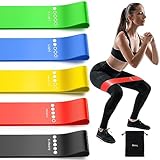


This guide explains how to choose resistance band strength for home workouts, mobility work, physical therapy, and assisted pull-ups. The goal is not to find the heaviest band available. It is to choose a setup that lets you move through a controlled range of motion, maintain good form, and progress gradually.
Decide These 3 Things First
1. Decide what exercises you will perform. For shoulder mobility, warmups, Pilates, and rehabilitation, a light band is usually more useful than a heavy one. For rows, chest presses, squats, and deadlifts, you may need medium or heavy resistance. Pull-up assistance is different: the band must be long enough to stretch from the bar to your foot or knee and strong enough to offset part of your body weight.
2. Decide whether you want loops or tubes. Flat loop bands are compact and convenient for glute exercises, lateral walks, stretching, and travel. Tube bands with handles are more versatile for upper-body movements and often work with a door anchor. A long power band is the better format for pull-up assistance and some barbell warmups.
3. Decide how you want to progress. A single heavy band is rarely as useful as a set containing several steps. Look for resistance levels that can be used individually or combined. A beginner may need roughly 2 to 15 pounds for shoulder work, 10 to 30 pounds for many arm exercises, and 20 to 60 pounds for lower-body movements. These are broad starting ranges, not universal ratings.
Choose the Right Size
Band dimensions affect resistance as much as the printed weight rating. Mini loop bands commonly measure about 10 to 13 inches around and 2 to 3 inches wide. They are useful around the thighs or ankles but may be too small for comfortable upper-body work.
Full-size flat loops are often about 41 to 45 inches long and 0.25 to 0.5 inches thick. Their widths may range from 0.5 to 1.25 inches. A narrow, thin band is generally easier to stretch, while a wide or thick band creates more resistance. Long power bands may measure 81 to roll? 208 inches? Need avoid typo. Usually 41 inch loop circumference, pullup bands 208 cm long. Say 80-84 inches.
Tube sets typically use cords about 48 to 52 inches long, with handles adding another 5 to 6 inches per side. For most standing exercises, 48 inches is workable. Taller users may prefer longer tubes or an adjustable anchor system. If you are over 6 feet tall, check the usable length rather than relying on the product photo.
For pull-up assistance, look for bands approximately 80 to 84 inches long when laid flat or looped. A 0.5-inch-wide band may provide light assistance, while bands 1.25 to 2 inches wide are often intended for substantially heavier assistance. Always check the maker’s stated weight range; width alone does not establish exact resistance.
Compare Material and Resistance Ratings
Natural latex is common because it stretches smoothly and returns to shape well. Latex-free thermoplastic rubber, often called TPR, can be a practical alternative for people with latex sensitivities. Neither material is automatically better for every buyer. Latex usually has a familiar, elastic feel, while TPR may be preferable where latex exposure is a concern.
Resistance labels are not standardized. One set may list a band as 10 pounds, while another may call a similar band “light.” Some brands state the approximate force at a specific stretch, such as 100 percent or 200 percent elongation. Others provide only color names. Treat any pound figure as a guide, not a guarantee of what you will feel in every exercise.
For general strength training, choose a set with at least four or five distinct levels. For example, a practical range might run from approximately 3 to 30 pounds for light tube work, or 10 to 50 pounds for a heavier full-body kit. If you are already strong or plan to train legs and back, a set topping out at 20 pounds may feel limiting.
Inspect Construction and Attachments
Construction determines whether a band is merely inexpensive or genuinely useful. On flat bands, inspect the edges for clean, even finishing and look for consistent thickness. On tube systems, check how the cord joins the handle, carabiner, ankle cuff, and door anchor. A metal clip should close fully, and a handle should not rotate excessively or expose a sharp edge.
Handles around 5 to 6 inches long suit most adults. Foam padding can improve comfort during high-repetition chest presses and rows, but soft foam is not a substitute for a secure connection. If a set includes an anchor, look for a thick protective sleeve rather than bare hardware rubbing directly against the tube.
Stacking is another useful construction feature. A kit with five 10-pound tubes may advertise 50 pounds of combined resistance, but the feel will vary depending on stretch and exercise angle. Make sure the handles and clips are designed to carry multiple tubes before assuming every listed level can be combined safely.
Prioritize Comfort and Performance
The best strength rating is one you can use with control. At the beginning of an exercise, a band should have slight tension rather than lying slack. At the hardest point, you should still be able to pause briefly without twisting your wrist, hiking your shoulder, or losing posture.
For upper-body exercises, a light or medium band is often the better starting point. For glute bridges, squats, and lateral walks, medium or heavy mini loops may be more appropriate. Pull-up bands require special caution: choose enough assistance to perform the intended repetitions, but not so much that the band launches you upward or makes the movement uncontrolled.
Texture matters, too. A fabric-covered loop can feel more comfortable against the skin and may resist rolling, but it is usually less versatile for stretching and may be harder to clean. Smooth latex is easier to wipe down but can pinch or migrate during lateral movements. If you expect long sets, comfort can matter more than a small difference in resistance.
Match the Price Tier to Your Use
Budget sets generally cost about $8 to $18. A five-piece flat loop kit around $9.98 or a basic five-band workout set around $7.98 can be reasonable for beginners, travel, warmups, and light lower-body work. At this tier, expect simpler packaging, fewer accessories, and less detailed resistance information.
Midrange sets typically cost $20 to $45. A tube set such as the WHATAFIT-style 150-pound kit, listed around $22.07, may include handles, ankle straps, a door anchor, and several tubes. The advertised 150 pounds refers to the combined maximum of the included pieces, not necessarily the resistance of one handle at every point in a movement.
Specialized or premium kits commonly range from $45 to $100 or more. You are paying for more precise resistance steps, reinforced sleeves, better attachment hardware, fabric construction, or a more complete training system. A five-level pull-up assistance set around $16.99 can be a sensible buy when the goal is assisted pull-ups, but it may be unnecessary for someone who only wants light stretching.
Check Warranty and Replacement Support
Before buying, look for a stated warranty of at least 90 days; one year is more reassuring for regular use. The policy should explain whether it covers cracking, snapping, defective clips, or only unopened products. A warranty that excludes normal stretching may still cover a faulty connection or premature material failure.
Replacement availability is especially important for multi-piece sets. Ask whether individual tubes, handles, anchors, or bands can be purchased separately. If one component fails and the entire set must be discarded, a low initial price may not represent good long-term value. Keep the receipt and inspect every piece before the first workout.
Consider Delivery and Storage, Not Assembly
Resistance bands usually require little or no assembly, but sets with handles and anchors may need a few minutes to connect. Confirm that all clips, cuffs, and handles are included in the box. A storage bag is useful for keeping latex away from direct sunlight, heat, and sharp objects.
Check package dimensions and delivery timing if you need the set for a trip or training program. Most kits weigh roughly 1 to 5 pounds, so shipping is usually inexpensive, but larger power-band systems can weigh more. Once delivered, unroll the bands, check for cuts or tears, and avoid using damaged equipment.
Spec Checklist
| Spec | Budget | Mid | Premium |
|---|---|---|---|
| Typical price | $8–$18 | $20–$45 | $45–$100+ |
| Format | Flat loops or basic tubes | Loops or tubes with handles | Modular tubes, power bands, or fabric loops |
| Resistance levels | 3–5 | 5–11, often stackable | 5–12+ with clearer increments |
| Useful dimensions | 10–13-inch mini loops; 41–45-inch flat loops | 48–52-inch tubes; 41–45-inch flat loops | 80–84-inch power bands or adjustable systems |
| Accessories | Usually bag or guide | Handles, cuffs, anchor, and bag | Reinforced anchor, multiple handles, guide, and storage |
| Warranty target | 90 days or stated return policy | At least 6–12 months | One year or longer, with replacement parts |
Red Flags
- Only color names are provided, with no dimensions or approximate resistance range.
- The product claims an unusually high total weight but does not explain whether it is combined resistance.
- There are visible seams, bubbles, cracks, flattened sections, or rough edges on arrival.
- Handles, clips, or door anchors are shown in photos but not clearly listed in the package contents.
- The warranty is missing, limited to an unclear period, or excludes every common failure.
- The band is too short to reach the intended anchor point without excessive tension.
- Instructions do not explain how to inspect, store, and safely attach the bands.
FAQ
What resistance band strength should a beginner use?
Start with a light or medium band that lets you complete 10 to 15 controlled repetitions. For shoulder and arm exercises, that may mean approximately 2 to 15 pounds. For lower-body movements, 10 to 30 pounds may be more practical. The right choice is the level that challenges the final repetitions without changing your form.
Is a heavier resistance band always better?
No. A band that is too heavy can shorten your range of motion and encourage jerky movements. A lighter band is often better for learning technique, warming up, rehabilitation, and high-repetition exercises. Buy a set with multiple levels if you want both light mobility work and heavier strength training.
How many resistance bands do I need?
One band can be enough for a focused routine, but three to five levels are more useful for full-body training. A practical starter setup includes one light band for shoulders and warmups, one medium band for arms and back, and one heavier band for legs. A five-piece set provides more room to progress.
How should resistance bands be stored?
Store them indoors in a cool, dry place away from direct sunlight, heaters, pets, and sharp edges. Keep tubes loosely coiled rather than tightly folded. Wipe off sweat with a damp cloth, let the bands dry completely, and inspect them before every workout. Replace any band showing cracks, cuts, whitening, or permanent distortion.