Key takeaways
- Pro: Smart Finish coordinates both zones so dishes land together without babysitting.
- Pro: FlexDoor reduces energy waste and speeds up preheat for single-cavity use.
- Con: Owner feedback notes the two cavities hold noticeably different capacities, limiting true symmetry for equal-load cooking.
A professional double oven solves a problem most home cooks and small-batch bakers hit the same way: two dishes that need different temperatures at the same time, and a single cavity that simply cannot accommodate both. The category has expanded well beyond built-in wall ovens into countertop and commercial-grade units, meaning the right machine depends entirely on whether you need a true second oven for holiday dinners, a dedicated proofing and baking station, or a commercial deck setup for a small bakery.
What separates a worthwhile double oven from a disappointing one comes down to a handful of specs that owners flag repeatedly in their feedback: actual usable capacity versus advertised volume, whether both zones hold temperature independently under load, and how many cooking modes work well enough to matter in practice. This roundup compares published specifications, listed prices, and recurring owner observations across the current market to help you identify which models deliver on their design intent and which ones leave gaps in real use.
Our top picks


As an Amazon Associate we earn from qualifying purchases at no extra cost to you. Ratings are shown as listed on Amazon.
Quick Picks
| Product | Best for | Price |
|---|---|---|
| Ninja DCT451 | Versatile everyday cooking with smart finish timing | $299.99 |
| Ninja DCT801 | Families needing maximum countertop capacity in stainless | $379.99 |
| Ninja DCT801BL | Large capacity at the lowest price in the XL line | $329.99 |
| HotKing Dual-Zone | Budget-minded buyers who prioritize dual-zone air frying | $239.99 |
| Ninja DCT821 | Premium finish with the fullest feature set from Ninja | $399.99 |
| VEVOR Commercial Gas Oven | Bakeries and restaurants needing two full-size decks | $4,899.90 |
| Samsung Smart Double Wall Oven | Built-in installation with steam cooking and Wi-Fi | $999 |
| Ninja DCT401 | Those who want the original double oven format with FlexDoor | $379.95 |
How We Picked
We filtered candidates against four criteria that owner reviews consistently surface as deal-breakers or deal-makers. First, independent zone control: a double oven is only as good as its ability to run two temperatures simultaneously without one cavity bleeding heat into the other. Second, usable interior capacity relative to footprint, because advertised quarts often shrink once you account for racks and clearance. Third, the breadth and reliability of cooking modes, since a unit advertising a dozen functions but delivering three well is a worse value than one offering six that all perform. Fourth, build quality at the listed price, evaluated through long-term owner feedback on door seals, control responsiveness, and finish durability.
The 8 Best Professional Double Ovens in 2026
Ninja DCT451
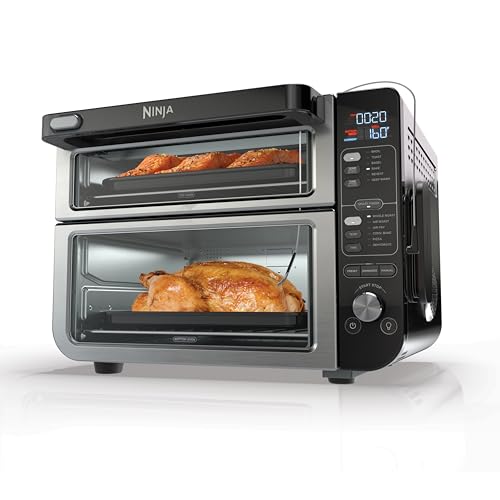
This is the strongest all-around pick for home cooks who want smart scheduling across two zones. The FlexDoor lets you open only the upper or lower cavity, reducing heat loss and making it practical for small meals that do not need full capacity. The integrated thermometer takes guesswork out of doneness, and FlavorSeal helps when one zone runs a strong-smelling dish while the other handles delicate baking.
- Pro: Smart Finish coordinates both zones so dishes land together without babysitting.
- Pro: FlexDoor reduces energy waste and speeds up preheat for single-cavity use.
- Con: Owner feedback notes the two cavities hold noticeably different capacities, limiting true symmetry for equal-load cooking.
Skip it if your primary need is two large equal-volume zones for roasting whole birds side by side.
Ninja DCT801
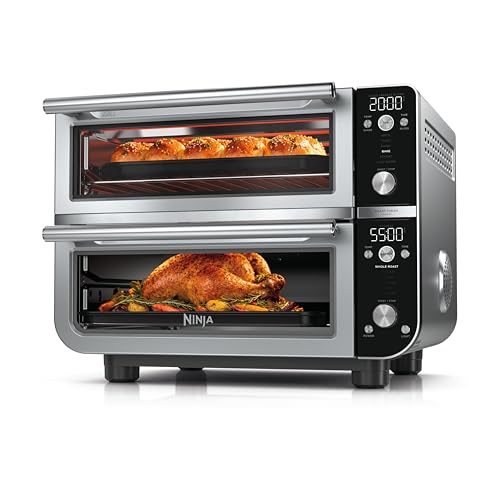
The 30.2-quart XL format targets households that cook in volume and want both cavities large enough for full sheet pans or a roasting dish each. At 12-in-1 cooking modes, it covers air frying, baking, roasting, and dehydrating across either zone independently. Stainless steel construction gives it a built-in look even on a countertop.
- Pro: Generous combined capacity in a countertop footprint that still fits most islands.
- Pro: Rapid top convection and air fry bottom create complementary airflow between zones.
- Con: The $379.99 price places it above units that offer similar mode counts with larger individual cavities.
Skip it if you already have ample counter space and would rather install a true built-in wall oven for a cleaner look.
Ninja DCT801BL
This is the same 30.2-quart, 12-in-1 XL platform in Cyberspace black, offered at $50 less than the stainless variant. For buyers who match a dark kitchen palette or simply want identical function at a lower entry price, this represents the best value within the XL Ninja line.
- Pro: Same interior and feature set as the DCT801 at a lower price point.
- Pro: The dark finish resists visible fingerprints and smudges between cleanings.
- Con: Fewer retailers stock the Cyberspace colorway, so returns and warranty service can involve more shipping friction.
Skip it if your kitchen design calls for stainless to match other appliances and the price gap does not justify a mismatch.
HotKing Dual-Zone
At $239.99, this is the entry point for anyone who specifically wants two independent air-fry-toaster zones without paying Ninja pricing. The 28-quart XL convection layout splits roughly evenly, and owners praise the value for apartment kitchens and secondary cooking stations.
- Pro: Lowest price in this roundup for a true dual-zone convection unit.
- Pro: 28-quart total capacity sits close to the Ninja XL tier despite the price gap.
- Con: Build quality and control precision receive more mixed feedback than premium competitors, with some owners noting temperature swings under load.
Skip it if you need consistent professional-level baking results and can stretch your budget toward the Ninja XL models.
Ninja DCT821
The Silver DCT821 is the priciest Ninja countertop double oven here at $399.99, positioned as the flagship for buyers who want the complete feature set without stepping up to a built-in wall unit. It shares the 12-in-1 architecture with the DCT801 line but adds a finish and trim treatment that reads more premium on display.
- Pro: Full feature parity with the XL line plus a distinctive silver finish.
- Pro: The 12 modes cover enough range to replace a microwave, toaster, and air fryer.
- Con: The $20 premium over the DCT801 stainless buys only a color option, not additional function.
Skip it if you already own a reliable air fryer and would not use more than three or four of the modes.
VEVOR Commercial Gas Oven
This is the only true commercial-grade unit in the list, built for bakeries, small restaurants, and serious production bakers. Two full-size decks powered by 40,000 BTU burners each, with selectable fan modes, deliver the sustained heat recovery that home units cannot match. At $4,899.90, it is a different category of commitment.
- Pro: Dual 40,000 BTU burners maintain temperature through heavy loading and repeated door openings.
- Pro: Natural gas fuel means lower operating cost per hour compared to electric commercial units.
- Con: Requires professional installation, a gas line, and dedicated kitchen space that most home kitchens lack.
Skip it unless you are outfitting a commercial kitchen or running a production-scale home bakery.
Samsung Smart Double Wall Oven
The Samsung NV51K6650DG/AA brings steam cooking and Wi-Fi to a built-in 30-inch double wall oven format. At $999, it is the most accessible true wall oven in this list, offering large combined capacity and fingerprint-resistant stainless. Steam cook gives it a capability none of the countertop units match.
- Pro: Steam cooking unlocks reheating and delicate protein preparation beyond what convection alone achieves.
- Pro: Wi-Fi connectivity allows remote preheat and monitoring from a phone or smart display.
- Con: Requires a dedicated wall cutout and 240-volt electrical service, adding installation cost on top of the listed price.
Skip it if you are renting, have limited cabinet access, or need a portable unit you can move between kitchens.
Ninja DCT401
The original Ninja Double Oven at $379.95 established the FlexDoor concept and still holds up with 12-in-1 modes in a slightly more compact footprint than the XL. It suits buyers who want proven Ninja platform reliability without the extra cost of the newer XL capacity.
- Pro: FlexDoor remains the most practical single-cavity access design in the category.
- Pro: Longest track record of owner reviews in the Ninja double oven line.
- Con: The smaller cavities mean less simultaneous cooking capacity than the DCT801 for the same price.
Skip it if volume cooking is your priority and the $20 difference to the DCT801 buys you meaningfully more usable space.
Buying Guide
Capacity and Zone Symmetry
Advertised quart totals can be misleading if one cavity is significantly smaller than the other. Check whether both zones fit the cookware you actually use, such as a full-size sheet pan or a 13-by-9 dish. A 30.2-quart total split unevenly between zones will force you into batch cooking just as often as a smaller unit with two equal chambers.
Cooking Modes and Control Precision
Twelve modes on a spec sheet means little if temperature holds drift under load. Prioritize units where owners consistently report stable results across the functions you will use most: air frying, convection baking, and roasting. A thermometer port and smart finish scheduling add real convenience but do not compensate for weak core heating elements.
Installation and Power Requirements
Countertop models like the Ninja and HotKing units need only a standard 120-volt outlet. The Samsung wall oven requires 240-volt service and a cutout that matches its 30-inch frame. The VEVOR commercial oven demands a natural gas line and professional venting. Factor installation labor into your decision, because it can add several hundred dollars to a built-in or commercial purchase.
Our Verdict
For most home cooks reading this in 2026, the Ninja DCT451 offers the best balance of capacity, smart features, and price at $299.99. Its FlexDoor and Smart Finish solve the everyday scheduling problem that makes a double oven worthwhile, and the thermometer integration removes the most common failure point in multi-zone cooking.
On a budget, the HotKing Dual-Zone at $239.99 delivers genuine dual-zone convection and air frying without the premium brand markup, making it the strongest value for apartment dwellers and secondary-kitchen setups.
If your kitchen is under renovation and you can install a wall oven, the Samsung at $999 adds steam cooking and Wi-Fi that no countertop unit can replicate, making it the right call when built-in form factor and steam are priorities over portability.
FAQ
Can a double oven replace a microwave?
The Ninja 12-in-1 models include a reheat mode that covers most microwave tasks, though they take longer because they rely on convection rather than radiation. For quick reheating of small portions, many owners still keep a microwave alongside the double oven.
Do dual-zone ovens use significantly more electricity than single units?
Running both cavities simultaneously consumes more power than one, but the FlexDoor design on Ninja models lets you use only the zone you need, keeping draw similar to a single toaster oven for everyday tasks.
Is a commercial gas oven worth it for a home kitchen?
Only if you already have a gas line routed to the intended location and plan regular production baking. The VEVOR’s two-deck design and 40,000 BTU burners deliver heat recovery that home units cannot match, but the installation complexity and space requirements make it impractical for most residential kitchens.
What is the difference between convection and air fry in a double oven?
Both circulate hot air, but air fry typically uses a more powerful fan at closer proximity to create a crisper surface with less preheat time. In the Ninja lineup, the top cavity handles rapid convection for baking while the bottom cavity delivers concentrated air-fry airflow, letting you use both functions simultaneously across zones.