Key takeaways
- Most people shopping for Google Chromebooks want a machine that handles web apps, video calls, and light document editing without a learning curve or a premium price tag. The market is crowded with models that look similar on a spec…
Most people shopping for Google Chromebooks want a machine that handles web apps, video calls, and light document editing without a learning curve or a premium price tag. The market is crowded with models that look similar on a spec sheet but deliver noticeably different experiences day to day. The variables that matter most are processor generation, RAM allocation, storage type, and screen quality.
What separates a worthwhile Chromebook from a disappointing one often comes down to whether the hardware matches the task. A 4 GB RAM machine with eMMC storage can feel sluggish after a few years of Chrome OS updates, while an ARM-based model with UFS storage and 8 GB RAM handles multitasking with far less friction. This roundup compares the published specs, current prices, and consistent owner feedback across eight popular models to help you narrow down the right pick.
Our top picks


As an Amazon Associate we earn from qualifying purchases at no extra cost to you. Ratings are shown as listed on Amazon.
Quick Picks
| Product | Best for | Price |
|---|---|---|
| HP Chromebook 14 (N4120) | Budget everyday use | $224.95 |
| HP Chromebook 14 (Student Bundle) | Students with accessory needs | $226 |
| Lenovo Chromebook 15 | Larger screen with more storage | $249.99 |
| Lenovo Chromebook m 14″ | Modern ARM performance and Gemini | $321.99 |
| Dell Chromebook 11 3100 (Renewed) | Ultra-budget or a child’s first laptop | $104.99 |
| HP Chromebook 14 (128 GB) | Everyday users needing extra local storage | $248.99 |
| Lenovo Chromebook m 15″ | Power users wanting a bigger display with ARM | $489.99 |
| HP 14 2-in-1 (Renewed) | Flexibility of a convertible form factor | $279.95 |
How We Picked
We focused on four criteria that define the real-world value of Google Chromebooks: processor capability relative to price, RAM and storage type (UFS outperforms eMMC, and 8 GB is noticeably better than 4 GB for heavy tabs), display quality and size, and long-term software relevance including whether the model supports newer Chrome OS features like Gemini integration. We also weighed owner-reported satisfaction around battery longevity and build quality.
The 8 Best Google Chromebooks in 2026
HP Chromebook 14 (Intel Celeron N4120)
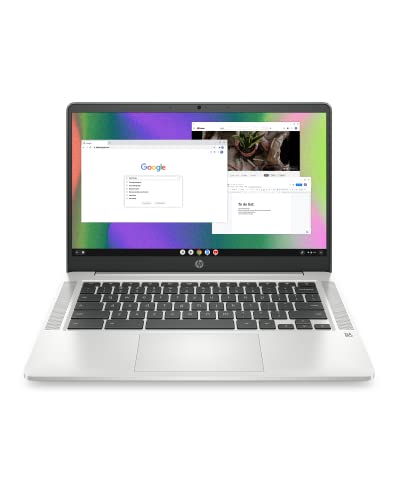
This is a straightforward entry-level Chromebook built for people who need reliable web browsing, email, and streaming without spending much. The thin design keeps it portable, and the 14-inch HD panel is a comfortable size for daily laptop use. Owner feedback consistently highlights the battery life and quiet operation under light loads. The quad-core N4120 handles typical Chrome OS workloads without complaint, and the listed 4K graphics output capability adds some flexibility for external displays. The con: 64 GB of eMMC storage fills quickly if you save files locally, and the 4 GB RAM ceiling limits tab-heavy multitasking. Skip this if you run more than ten or so tabs regularly or need generous local storage.
HP Chromebook 14 (Student Bundle with CUE Accessories)
Functionally identical to the model above in core hardware, this version adds a bundle of CUE accessories and a stated 14-hour battery life figure, making it attractive for students who want a ready-to-go package. The inclusion of a webcam, HDMI, and both USB-A and USB-C ports covers the basics for classroom and home use. Owner reviews note the convenience of receiving accessories in one purchase. The N4120 is explicitly noted as outperforming the older N4020, which reassures buyers comparing to previous-generation machines. The con remains 64 GB of eMMC storage paired with 4 GB RAM. Skip this if you do not need the bundled accessories, since you can likely find a better standalone price elsewhere.
Lenovo Chromebook 15 (Celeron N4500)
The 15.6-inch FHD panel is the headline here — significantly larger and sharper than the 14-inch HD screens common at this price. The newer Intel Celeron N4500 represents a step up from the N4120 in both architecture and efficiency, and 128 GB of storage gives users meaningful headroom for offline files. This suits anyone who wants a desktop-replacement feel without a desktop price. Owner feedback praises the screen size and the snappier feel compared to older Celeron models. The con: 4 GB RAM is still the ceiling for multitasking, and the larger chassis trades portability for display real estate. Skip this if you carry your laptop everywhere and prefer a smaller footprint.
Lenovo Chromebook m 14″ (MediaTek Kompanio 540)
One of the most future-proof options in this roundup, this ARM-based Chromebook pairs the MediaTek Kompanio 540 with 8 GB RAM and UFS storage, a combination that feels noticeably faster under load than Intel Celeron machines with half the memory. The 14-inch WUXGA IPS display offers better color accuracy and viewing angles than the HD panels found on most competitors here. Built-in Google Gemini support adds a layer of AI assistance that is becoming standard in 2026 Chrome OS releases. The Mali-G57 MC2 GPU handles light creative tasks competently. The con: 64 GB of UFS storage is faster than eMMC but still limited, so cloud storage planning is essential. Skip this if you specifically need x86 Linux app compatibility.
Dell Chromebook 11 3100 (Renewed)
At $104.99, this renewed model is the absolute floor of the Chromebook market. The 11.6-inch panel, Celeron N4020, 4 GB RAM, and 16 GB flash storage paint a picture of a machine built for minimal use — browsing a handful of sites, streaming video, or serving as a child’s first computer. As a renewed device, it carries the caveat of prior use, though owners generally report it remains functional for light tasks. The con: 16 GB storage is extremely tight and will require almost exclusive reliance on cloud. Skip this if the buyer needs anything beyond casual web use or if a new device within $200 is feasible.
HP Chromebook 14 (Intel Celeron N4120, 128 GB)
This variant doubles the storage of the base HP 14 model while keeping the same N4120 processor and 4 GB RAM, making it a smarter choice for anyone who saves documents, downloads media, or uses offline Google Docs. The price premium over the 64 GB version is modest, and the added capacity removes the most common complaint from owners of the base model. It retains the thin design and solid battery life. The con: you are still capped at 4 GB RAM, so multitasking performance does not improve over the cheaper version. Skip this if you are willing to pay slightly more for an 8 GB RAM machine, since the storage upgrade alone does not address the memory bottleneck.
Lenovo Chromebook m 15″ (MediaTek Kompanio 540)
The larger sibling of the 14-inch ARM model, this Chromebook stretches the WUXGA IPS display to 15.3 inches while keeping the Kompanio 540, 8 GB RAM, and Mali-G57 MC2 GPU. Storage doubles to 128 GB of UFS, directly addressing the main weakness of its smaller counterpart. Google Gemini support ensures long-term software relevance. Owner reviews highlight the comfortable screen for productivity and the responsive feel of UFS storage. The con: $489.99 is the highest price here, and the ARM-based processor means some niche x86 applications remain unavailable. Skip this if you want the best value per dollar in Chrome OS — the 14-inch version offers nearly the same experience for $168 less.
HP 14 2-in-1 Chromebook (Renewed)
Convertibles add versatility to the Chromebook world, and this renewed 14-inch FHD 2-in-1 lets you switch between laptop and tablet mode. The Intel processor, 4 GB RAM, and 64 GB storage place it in the same performance tier as the base HP 14 models, so you are paying for the form factor rather than raw speed. The FHD panel is an upgrade over the HD screens on similarly priced non-2-in-1 options. As a renewed device, cosmetic wear is possible. The con: the 4 GB and 64 GB combination limits its usefulness for demanding workflows. Skip this if you do not genuinely need a touchscreen or foldable hinge — a standard clamshell at this price offers better specs.
Buying Guide
RAM and Storage Type Matter More Than Raw Capacity
Chrome OS is efficient, but 4 GB of RAM is increasingly the bare minimum as the operating system adds features like Gemini. If your budget allows, 8 GB eliminates the tab-reload behavior that frustrates owners of lower-RAM models. Equally important is storage technology: UFS read and write speeds far exceed eMMC, so a 64 GB UFS drive will feel more responsive than a 128 GB eMMC drive during everyday file operations. Prioritize RAM and storage type before chasing the largest number on the box.
Intel Celeron vs. ARM: Know Your Software Needs
Most Chromebooks still use Intel Celeron or Pentium processors, but the Lenovo m-series ARM models represent a growing segment with advantages in battery efficiency and AI feature support. If you rely on Android apps from the Play Store, either architecture works well. If you need Linux terminal access or x86-only development tools, stick with Intel. For pure Chrome OS use with a focus on future software updates, ARM-based models are increasingly well supported and deliver a smoother experience with 8 GB RAM.
Display Resolution and Size Shape Daily Comfort
The jump from HD (1366 x 768) to FHD (1920 x 1080) or WUXGA is significant for text clarity and media consumption. A 14-inch FHD panel is the sweet spot for portability and readability. If you work in spreadsheets or split-screen often, the 15.6-inch or 15.3-inch options earn their bulk. IPS panels offer better viewing angles than TN or budget LCD variants, which matters if more than one person views your screen during a presentation or class.
Our Verdict
Our top pick is the Lenovo Chromebook m 14-inch. It balances a modern ARM processor, 8 GB RAM, fast UFS storage, a high-quality WUXGA IPS display, and built-in Gemini support at a price that undercuts several older-architecture competitors. For the strictest budget, the HP Chromebook 14 with the N4120 at $224.95 remains a solid no-nonsense choice that covers basic needs without compromise on battery or portability. If your priority is screen real estate for productivity or media, the Lenovo Chromebook 15 with its 15.6-inch FHD panel and 128 GB storage at $249.99 is the value leader in that size class.
FAQ
Can a Chromebook handle work and school tasks in 2026?
Yes. Google Workspace, Microsoft Office web apps, video conferencing via Zoom or Meet, and browser-based tools run well on any model with at least 4 GB RAM. For heavier multitasking, 8 GB RAM models provide noticeably smoother performance.
Are renewed Chromebooks a good value?
Renewed models like the Dell 11 3100 and HP 2-in-1 can save significant money, but you sacrifice warranty length and receive a device with prior use history. For light or temporary use, they work well; for long-term daily driving, a new model is usually worth the difference.
Do Chromebooks need a lot of local storage?
Most Chromebook users rely on cloud storage, so 64 GB is adequate for the operating system, cached files, and occasional downloads. However, if you frequently work offline or download media, 128 GB or more saves the hassle of constantly clearing files.
What is Google Gemini on a Chromebook?
Gemini is an AI assistant built into recent Chrome OS versions, available on newer hardware like the Lenovo m-series. It helps with summarizing, writing, and contextual tasks directly on the device. Support depends on the processor and memory specifications, so check whether a model lists Gemini compatibility before buying.