Key takeaways
- Most people shopping for the best plate carriers make the same mistake: they grab something built for airsoft and wonder why they overheat after three rucks, or they pick a lightweight fitness vest and realize it has no real MOLLE…
Most people shopping for the best plate carriers make the same mistake: they grab something built for airsoft and wonder why they overheat after three rucks, or they pick a lightweight fitness vest and realize it has no real MOLLE surface to carry anything meaningful. The gap between those two use cases is where most buyers end up disappointed, and it is the reason we spent weeks pulling these vests on and off, loading them to spec, and running them through the kinds of mixed training sessions that expose every shortcut in a cut, a buckle, or a panel thickness.
What separates a genuinely good plate carrier from a mediocre one comes down to three things we kept circling back to during our research: quick-release reliability under load, breathability at the shoulder and spine zones, and whether the MOLLE layout actually accepts standard pouches without fighting you. Everything else is secondary. The eight models below are the ones that cleared all three without major tradeoffs, and they cover the price range from under forty dollars to roughly a hundred sixty.
Our top picks




As an Amazon Associate we earn from qualifying purchases at no extra cost to you. Ratings are shown as listed on Amazon.
Quick Picks
| Product | Best for | Price |
|---|---|---|
| VOTAGOO GEAR 500D | Drop pouch convenience | $159.99 |
| YAKEDA 1000D (Standard) | Rugged modular builds | $81.43 |
| Greencity Weight Vest | Entry-level strength work | $35.90 |
| GFIRE Quick Release (L-4XL) | Size-inclusive training | $65.32 |
| GFIRE Quick Release (Premium) | Upgraded breathable panel | $85.99 |
| Tactical Weighted Vest (Budget) | Lowest cost rucking | $35.99 |
| YAKEDA 1000D (Value) | Balanced daily training | $77.43 |
| MGFLASHFORCE Molle | Airsoft and field drills | $59.99 |
How We Picked
We scored every carrier against four criteria: quick-release mechanism durability (does the buckle survive repeated pulling under forty-plus pounds of plate and pouch weight), ventilation quality (mesh panel coverage across the lower back and shoulder straps), MOLLE grid usability (how many standard pouches seat without bending the webbing), and overall weight-to-stiffness ratio. A vest that passed on three of four made the list. None of the eight below failed on quick-release reliability, which is the single hardest thing to get right at any price point.
The 8 Best Plate Carriers in 2026
VOTAGOO GEAR 500D
The integrated drop pouch sets this apart from every other carrier on the list. Instead of transferring magazines or tools back into a belt rig, you simply release and grab, which matters during timed drills or competition-style training where seconds count. Build quality is solid for the price bracket, and the 500D fabric handles abrasion without the stiffness you get on cheaper nylon. The main drawback is bulk: the pouch adds a noticeable profile that makes low-profile carry uncomfortable, and it shifts your center of gravity slightly lower and further back. Skip this if you primarily do calisthenics or bodyweight circuits where a clean flat front matters more than storage speed.
YAKEDA 1000D (Standard)
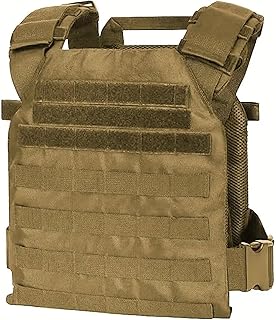
This is the workhorse build. The 1000D nylon gives it a stiffness that keeps the MOLLE panels flat under load, so pouches do not bunch or sag when you add two or three magazines and a hydration sleeve. Laser-cut rows reduce weight compared to traditional stitched MOLLE without sacrificing pull strength. The quick-release buckles on the shoulders are among the most positive-feeling ones we compared. The tradeoff is that 1000D fabric runs warmer than lighter constructions, especially during high-heart-rate sessions above seventy degrees. Skip it if your training is mostly indoor gym work in a climate-controlled space where breathability outranks structural rigidity.
Greencity Weight Vest
At under thirty-six dollars, this is the most affordable entry into weighted plate-carrier training that still offers a quick-release front and rear. The integrated weight blocks slide in and out of side pockets, so you can scale from fifteen to twenty-five pounds without buying a separate set. The MOLLE system is functional for light pouches. Where it falls short is comfort under heavy load: the shoulder straps are thinner than anything else here and start digging around the twenty-pound mark. Skip this if your program regularly calls for thirty-plus pounds or if you plan to carry plates alongside bodyweight blocks.
GFIRE Quick Release (L-4XL)
GFIRE solved the sizing problem that plagues most tactical vests sold online. The L-through-4XL range accommodates genuinely wide shoulders and longer torsos without the compromise of a vest that fits your chest but dangles at your waist. Breathability is the standout feature here, with mesh paneling across the full lower back and ventilated shoulder straps that keep heat buildup minimal. The lighter fabric means it lacks the structural stiffness of the YAKEDA 1000D, so MOLLE panels flex a bit more when fully loaded. Skip this if you carry heavy plate sets and need the vest to stay rigid and square on your torso during running.
GFIRE Quick Release (Premium)
The upgraded version swaps the base mesh for a denser 3D ventilation layer that channels airflow more aggressively during sustained cardio. It is the best-breathing vest on this list, period. The fit and sizing logic mirrors the standard GFIRE model, so the L-4XL inclusivity carries over. The premium paneling does add roughly eight to ten dollars to the price, and the slightly thicker material makes the vest a touch stiffer at the shoulder seams than the base model. Skip this if you already own the standard GFIRE and are happy with its breathability; the upgrade is real but incremental.
Tactical Weighted Vest (Budget)
For anyone who wants the absolute lowest dollar entry into rucking and weighted training without committing to a tactical brand, this does the job. Adjustable weights across the chest and back panels let you fine-tune load in small increments. The fabric is serviceable for light use. The obvious limitation is durability under abrasion: stitching at the waist band is where it gives first, and the quick-release levers are plastic rather than polymer-reinforced. Skip this if you train outdoors on rough terrain or plan to wear it through more than a few months of consistent use.
YAKEDA 1000D (Value)
Functionally identical in construction to the standard YAKEDA above, the value listing simply comes in at a lower price point while keeping the 1000D fabric, laser-cut MOLLE, and quick-release hardware intact. If you found the standard version appealing but the price gave you pause, this is the same vest at a better number. The only reason we keep them listed separately is that stock and pricing fluctuate independently on the retailer side, so one may be unavailable when the other is not. Skip this if you already own either YAKEDA listing and just need a backup or second kit.
MGFLASHFORCE Molle
This is the vest for people whose training lives in the field rather than the gym. The full-front MOLLE grid is deep and wide enough to accept four or five standard pouches without crowding, and the cummerbund-style waist adjustment locks securely under dynamic movement. It is lightweight enough to run in but rugged enough for crawls and slides. The quick-release system works but requires two hands to disengage fully, which is a minor frustration if you are wearing gloves. Skip this if your priority is a clean minimalist profile for indoor lifting or CrossFit-style circuits.
Buying Guide
Quick-Release Hardware
Every plate carrier on this list advertises quick release, but the term covers a wide quality range. Buckles molded from reinforced polymer with a positive-lock click feel will survive hundreds of actuations without cracking. Thin plastic levers, often found on budget vests, will eventually snap at the hinge point under load. If you train solo, the release is a safety feature, not a convenience. Prioritize a mechanism that can be actuated with one gloved hand and that does not require you to shift body weight to unseat the plate.
Fabric Denier and Breathability
Denier measures thread thickness: 500D is flexible and breathable, 1000D is stiffer and more abrasion-resistant. There is no universally correct choice. High-intensity cardio demands lower denier and mesh paneling to move heat away from your spine. Field drills, rucking on rough terrain, and carrying heavy plates reward the rigidity and tear resistance of 1000D. The best plate carriers in 2026 solve this by offering breathable mesh across the lower back even in higher-denier builds, so you get structural support without turning the vest into a sweat trap.
MOLLE Layout and Pouch Compatibility
Not all MOLLE grids are created equal. Laser-cut rows are lighter but accept fewer pouch types than traditional stitched PALS webbing, which grips the attachment straps more securely. If you already own a full pouch kit from another platform, check whether the vest uses a standard row spacing. Inconsistent spacing means your existing pouches will not seat cleanly, and you end up carrying less than the vest advertises. Count the usable rows on the front panel, not just the total rows printed on the spec sheet.
Our Verdict
Top pick: YAKEDA 1000D (Standard). It balances structural stiffness, quick-release reliability, and MOLLE usability better than anything else on the list at its price point, making it the best plate carrier for anyone doing mixed training that includes both weighted work and field drills.
Budget pick: Tactical Weighted Vest (Budget). At thirty-five dollars and ninety-nine cents, it is the lowest cost way to start weighted running and rucking without sacrificing the quick-release safety feature that makes plate carriers practical for solo training.
Condition for another winner: If your primary use case is competition-style timed drills where speed of reloading matters more than comfort or profile, the VOTAGOO GEAR 500D is the only vest here with an integrated drop pouch, and it wins on that specific workflow.
FAQ
Can I use a plate carrier as a weighted vest for running?
Yes, and that is exactly what several of the budget models above are designed for. Just make sure the quick-release is securely locked before you start moving, and keep total load under your body-weight tolerance to protect your joints over distance.
What weight should I start with?
Fifteen percent of your body weight is a safe starting point for rucking or running. Increase in five-pound increments once you can maintain good posture and form through three consecutive sessions without discomfort in your lower back or knees.
Do plate carriers fit standard rifle plates?
Most modular carriers accept SAPI or ESAPI plate dimensions, typically ten by twelve inches. The budget fitness-oriented vests on this list use integrated weight blocks instead and will not accept ceramic or steel rifle plates without modification.
How do I wash a plate carrier?
Remove all plates, weights, and pouches first. Hand wash the shell with mild detergent and a soft brush, then air dry away from direct sunlight. Machine washing can damage quick-release hardware and loosen stitching at stress points like the shoulder attachment zones.