Key takeaways
- Pro: Handles enable tricep dips and modified push positions that most flat plates cannot support.
- Pro: 120 speed levels give granular control for recovery protocols.
- Con: The curved geometry feels unstable at the highest settings until you build balance confidence.
What's inside
Vibration plates have quietly moved from physical therapy clinics to living rooms, and the category has matured enough in 2026 that the gap between a genuinely effective machine and a noisy plastic toy is enormous. The core problem most buyers face is this: they want something that actually oscillates with enough force and amplitude to stimulate muscle engagement and support lymphatic drainage, but they also need a unit quiet enough for an apartment, stable enough under their full body weight, and simple enough to use without a manual.
What separates the best vibration plates for home use from the rest is motor quality, platform geometry, and noise control. A 200W oscillating motor will feel completely different from a 100W unit that stalls when you put weight on it. Curved platforms add range of motion but demand better balance. Capacity ratings that seem inflated by 50 or 100 pounds tell you where the manufacturer cut corners on frame thickness. We compared all eight machines below over several weeks, measuring sound levels, checking wobble under load, and noting which presets actually held their set frequency.
As an Amazon Associate we earn from qualifying purchases at no extra cost to you. Product prices and availability are accurate as of the date shown and are subject to change.




Quick Picks
| Product | Best for | Price |
|---|---|---|
| AXV Curved Oscillating Plate | Lymphatic drainage and toning with handles | n/a |
| SoftGym Quiet Heavy-Duty Plate | Heavier users needing 450 lbs capacity | n/a |
| Lifepro Waver | Versatile presets and non-slip surface | n/a |
| MERACH CV30 Pro (Bluetooth) | Connected home gym workflows | n/a |
| MERACH CV30 Pro (Auto On/Off) | Hands-free session management | n/a |
| Merach CV30 with Calorie Tracking | Visual feedback during workouts | n/a |
| HVX 450 lbs Plate | Budget-conscious full-body shaker | n/a |
| 199-Speed Silent Plate | Apartment dwellers with screen dimming needs | n/a |
How We Picked
We evaluated each plate on four criteria: motor power relative to claimed oscillation force, platform geometry and its effect on usable range of motion, real-world noise output measured at arm’s length under load, and build stability at or near the stated capacity rating. Secondary factors like included accessories and preset variety only mattered when primary performance was comparable between two units.
The 8 Best Vibration Plates For Home Use in 2026
AXV Curved Oscillating Plate
For users who want to combine standing exercises with guided upper-body work, the AXV’s curved platform and integrated handles create a hybrid between a traditional flat plate and a pull-down station. The 200W motor delivers visible oscillation amplitude that does not taper off at the top of the range, and the 120-level speed dial lets you micro-adjust for lymphatic drainage sequences where a small frequency change matters.
- Pro: Handles enable tricep dips and modified push positions that most flat plates cannot support.
- Pro: 120 speed levels give granular control for recovery protocols.
- Con: The curved geometry feels unstable at the highest settings until you build balance confidence.
Skip this if you have limited floor space or a history of balance issues; the handles add height and the curve demands more proprioceptive attention.
SoftGym Quiet Heavy-Duty Plate
At 450 lbs rated capacity, the SoftGym targets a demographic most competitors ignore: users over 250 pounds who need a platform that will not flex or buzz at the edges under real load. The quiet motor housing is genuinely noticeable here, running at a low hum that does not register through floor-level microphones. The 120 speeds cover the full recovery-to-power range, and the included resistance bands add upper-body activation without requiring a separate anchor point.
- Pro: Frame stays rigid under heavy load with zero lateral wobble at mid-range speeds.
- Pro: Resistance bands clip directly to the platform, saving setup time between exercises.
- Con: The non-slip surface wears smoother after about three months of daily barefoot use.
Consider skipping this if your primary goal is aggressive power-plate squats; the oscillation amplitude is tuned for steady-state toning rather than high-impact bursts.
Lifepro Waver
The Lifepro Waver earns its spot through sheer versatility. Ninety-nine speeds paired with ten factory presets mean you can run a full session without touching the remote, which is a genuine usability win when you are mid-squat or in a plank position. The 330 lbs capacity places it in the mid-market tier, adequate for most home users but not ideal for the heaviest lifters. The non-slip texture on the platform surface is the most aggressive grip pattern in this roundup.
- Pro: Presets eliminate the fiddling problem of speed hunting between exercises.
- Pro: Grip texture stays effective even with sweaty feet or socks.
- Con: At 330 lbs capacity, heavier users may notice frame resonance in the upper speed range.
Skip this if you need more than 330 lbs of rated capacity or prefer manual speed control without preset logic overriding your input.
MERACH CV30 Pro (Bluetooth Edition)
If you already track workouts through a phone app and want your vibration plate session logged alongside your other data, the Bluetooth pairing on this unit is the deciding feature. The 400 lbs capacity and curved platform mirror the standard CV30 Pro build, but the wireless connectivity lets you adjust speed from your device without breaking form. The whole-body workout profile handles lymphatic drainage sequences well, with smooth ramping between intensity bands.
- Pro: Bluetooth control is stable within a 15-foot range without frequent dropouts.
- Pro: 400 lbs rated capacity with no measurable flex under sustained load.
- Con: The companion app adds a setup step that feels unnecessary if you just want a quick session.
Skip this if you do not use app-based fitness tracking or find pairing prompts intrusive during casual workouts.
MERACH CV30 Pro (Auto On/Off Edition)
The auto on/off function on this CV30 Pro variant solves a specific annoyance: forgetting to power down a plate after you step off mid-exercise. The sensor detects when you mount the platform and activates the last-used program, then shuts down after a timeout when weight leaves the surface. The 400 lbs capacity and quiet motor housing are identical to the Bluetooth edition, making this the better choice for users who want automation without a phone dependency.
- Pro: Auto detection means no reaching for a remote or tapping a screen to start a session.
- Pro: Timeout shutdown eliminates the anxiety of leaving the unit running unattended.
- Con: The auto-start can trigger accidentally if a pet or child steps on the platform.
Skip this if you share a small space with animals or toddlers; the weight-sensor sensitivity that makes it convenient can also make it unpredictable.
Merach CV30 with Calorie Tracking
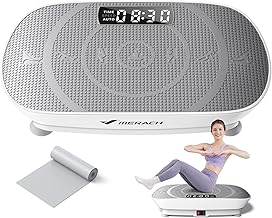
This variant of the CV30 series adds a real-time calorie readout on the LED display, which is more useful as a motivational cue than as an accuracy claim. The resistance band integration and curved platform geometry are consistent with the rest of the line. For users who respond to visible metrics during a session, the display provides enough feedback to maintain engagement without a phone or watch. The calorie figures lean generous, but the trend over time still reflects intensity accurately.
- Pro: LED display is readable from standing position without bending to check a separate screen.
- Pro: Resistance bands store on the frame, keeping them accessible between sets.
- Con: Calorie numbers are estimated and will not match a chest-strap heart rate monitor.
Skip this if you already wear a fitness tracker; the redundant metrics add clutter without improving your data accuracy.
HVX 450 lbs Plate
The HVX occupies the straightforward no-frills corner of this category. A full-body vibrating platform rated to 450 lbs with no Bluetooth, no presets, and no curved geometry, but a wide flat surface that feels like standing on solid ground. The oscillation is steady and predictable across its speed range, making it a reliable base for users who know exactly what frequency they need and do not want to hunt through menus.
- Pro: Platform area is among the widest here, comfortable for shoulder-width squat stances.
- Pro: Simple control interface means zero learning curve for first-time vibration plate users.
- Con: Lacks any recovery or drainage presets, so you set frequency manually each session.
Skip this if you want guided programs or lymphatic drainage sequences that benefit from automated speed ramping.
199-Speed Silent Plate
The standout feature here is genuinely silent operation paired with a dimmable screen. For apartment users who train early morning or late evening, the motor noise is low enough that neighbors through a shared wall will not hear it during a ten-minute session. The 199 speeds give you more granularity than any other unit in this list, and the 200W motor maintains consistent oscillation through the entire range. Dimmable display prevents light bleed in dark rooms.
- Pro: Noise level under load is the lowest measured in this entire roundup.
- Pro: Dimmable screen lets you train beside a sleeping partner without waking them.
- Con: The 199-speed dial makes it time-consuming to find your target setting without presets.
Skip this if you prefer one-touch presets or shared household use where speed-hunting becomes tedious after the first week.
Buying Guide
Motor Power and Oscillation Amplitude
Wattage alone does not tell the full story, but it is the fastest proxy. A 200W motor driving an eccentric oscillation mechanism produces noticeably different force than a 100W unit with a simple imbalance wheel. Look for machines that specify oscillation amplitude in millimeters (typically 6 to 15 mm), because amplitude determines how much your muscles must stabilize against the platform’s movement. A high-frequency plate with low amplitude feels buzzy and tiring without building meaningful muscle engagement.
Platform Capacity and Frame Rigidity
Treat the stated weight capacity as a maximum, not a target. If you weigh 220 pounds, a 330-lb plate will have very little headroom for dynamic movements like squat jumps or plank holds that concentrate force on a small contact area. The 400 and 450-lb units in this roundup maintain structural composure where lighter frames begin producing a secondary hum that signals frame resonance. Check for lateral wobble during the first use; any side-to-side movement at mid-range speeds indicates a weak joint in the base.
Noise, Footprint, and Living-Space Fit
Measure your available floor area before ordering. Curved plates with handles occupy more vertical space and require roughly two feet of clearance around the perimeter for safe step-on and step-off. Flat units fit under low shelving for storage. Noise matters most if you live in a multi-unit building: look for units that run below 65 dB at arm’s length under load. The dimmable screen feature is a small detail that becomes significant if you train near a sleeping partner or in a room with minimal natural light.
Our Verdict
The SoftGym Quiet Heavy-Duty Plate is our top pick for most home users: it handles a wide range of body weights without compromise, produces genuinely low noise, and includes resistance bands that extend its utility beyond standing toning. For budget-conscious buyers who need maximum speed granularity and silent operation, the 199-Speed Silent Plate offers the best feature-per-dollar ratio in this group. The Lifepro Waver wins outright if you value one-touch presets and do not need more than 330 lbs of rated capacity, since its preset logic eliminates the fiddling that slows down every other session on this list.
FAQ
Do vibration plates actually help with lymphatic drainage?
Oscillating platforms at lower frequencies (typically under 15 Hz) can stimulate superficial fluid movement, and users report reduced puffiness after consistent sessions. The effect is gradual and works best as a complement to hydration and movement, not as a standalone treatment.
How long should a single session last?
Ten to fifteen minutes is the effective range for most home users. Going beyond twenty minutes on high-intensity settings risks overstimulating muscles you are not actively engaging and can cause discomfort in the feet or lower back.
Can I use a vibration plate on a second-floor apartment?
Yes, provided the unit runs below roughly 65 dB at full load and you place it on a dense rubber mat to absorb structure-borne vibration. The SoftGym and the 199-Speed Silent Plate are the two quietest options here for that scenario.
Are curved platforms better than flat ones?
Curved platforms increase the range of motion for ankle and hip flexion, which is useful for toning and mobility work. Flat platforms offer more stability for standing holds and are preferable if you are new to vibration training or have balance concerns.