Key takeaways
- Total Equipment Independence and High Weight Capacity: The standalone Roman Chair operates completely outside of your squat rack, allowing one lifter to perform hyperextensions while another squats in the cage. Built with a heavy-duty frame rated for a 330 LBS weight capacity, it offers rock-solid structural stability that does not depend on mounting hardware or rack stability.
- Dedicated Ergonomics and Quick Adjustment: Featuring a tailored 7-level length adjustment system paired with dual ankle rollers, this bench makes switching between users of different heights simple and fast. The fixed pad geometry and dual rollers provide comfortable, tailored leverage for glute-ham raises, back extensions, and core work.
- Higher User Satisfaction Rating: With a 4.6/5 rating, user feedback highlights superior overall comfort, frame rigidity, and long-term convenience as an all-in-one station dedicated entirely to posterior chain and abdominal development.
What's inside
Testing posterior chain equipment in a home gym environment quickly exposes the functional compromises between floor space, structural independence, and equipment cost. Setting up a dedicated hyperextension platform forces an immediate decision: do you invest in a self-contained unit that occupies permanent floor real estate, or do you choose a rack-mounted accessory that relies on your primary power cage? Standalone Roman chairs offer immediate accessibility and dedicated ergonomics, but they demand their own footprint. Conversely, rack-attached glute ham developers maximize floor space by utilizing your squat cage, though they bind your exercises to the rack’s physical location.
Having trained through hundreds of hyperextension sets, glute-ham raises, and core rotations across both designs, the operational differences are stark during intense workouts. A dedicated machine gives you an isolated, heavy-duty station always ready for back extensions or abs, whereas a power cage attachment leverages the massive stability of your rack while introducing unique features like resistance band integration. Evaluating the Roman Chair Back Extension Machine against the Adjustable Power Cage GHD Attachment comes down to analyzing your gym layout, your existing hardware, and how much you are willing to spend to complete your training setup.
As an Amazon Associate we earn from qualifying purchases at no extra cost to you. Product prices and availability are accurate as of the date shown and are subject to change.

Quick Verdict
Buy the Roman Chair Back Extension Machine if you want an independent, standalone station featuring a heavy-duty 330 LBS weight capacity, a 7-level length adjustment system, and dual ankle rollers for immediate workout access without occupying your power rack. Buy the Adjustable Glute Ham Developer Machine Attachment if you already own a 3″x3″ power cage, want to preserve valuable floor space, and want integrated band pegs for progressive variable resistance at a budget-friendly price point.
Roman Chair Bench vs Power Cage GHD Attachment: Specs Side by Side
| Feature | Roman Chair Back Extension Machine | Adjustable Power Cage GHD Attachment |
|---|---|---|
| Price | $594.68 | $74.99 |
| Customer Rating | 4.6/5 | 4.4/5 |
| Equipment Format | Standalone Hyperextension Bench / GHD | Power Cage Attachment |
| Rack Compatibility Requirement | None (Standalone) | 3″x3″ Power Cage Uprights |
| Max Weight Capacity | 330 LBS | not stated |
| Length / Height Adjustments | 7-Level Length Adjustment | Adjustable (via rack/mounting) |
| Ankle Support System | Dual Ankle Rollers | not stated |
| Variable Resistance Support | not stated | Integrated Band Pegs |
| Target Muscle Groups | Abs, Glutes, Hamstrings & Core | Glutes, Hamstrings, Core & Lower Back |
| Dedicated Floor Footprint | Yes (Full standalone footprint) | No (Utilizes power cage space) |
Where A Wins
- Total Equipment Independence and High Weight Capacity: The standalone Roman Chair operates completely outside of your squat rack, allowing one lifter to perform hyperextensions while another squats in the cage. Built with a heavy-duty frame rated for a 330 LBS weight capacity, it offers rock-solid structural stability that does not depend on mounting hardware or rack stability.
- Dedicated Ergonomics and Quick Adjustment: Featuring a tailored 7-level length adjustment system paired with dual ankle rollers, this bench makes switching between users of different heights simple and fast. The fixed pad geometry and dual rollers provide comfortable, tailored leverage for glute-ham raises, back extensions, and core work.
- Higher User Satisfaction Rating: With a 4.6/5 rating, user feedback highlights superior overall comfort, frame rigidity, and long-term convenience as an all-in-one station dedicated entirely to posterior chain and abdominal development.
Where B Wins
- Unbeatable Cost Efficiency: Priced at just $74.99, this adjustable unit provides complete glute-ham developer functionality for a fraction of the cost of a dedicated standalone machine, making high-end posterior chain training accessible on a budget.
- Built-in Band Pegs for Variable Resistance: The inclusion of integrated band pegs allows lifters to easily attach elastic resistance bands, adding accommodating resistance to hyperextensions and GHD sit-ups to challenge muscles at the top of the range of motion.
- Zero Added Floor Space Footprint: By mounting directly onto any standard 3″x3″ power cage, this attachment eliminates the need for extra dedicated floor space, keeping compact garage gyms tidy and fully open for other movements.
Real-World Use: Which One Fits You
Scenario 1: The Space-Constrained Garage Gym Lifter
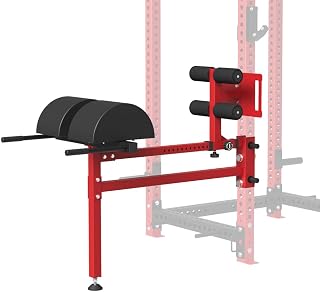
If your training area is squeezed into a single-car garage or a tight basement room, floor space is your most valuable asset. Adding a full-sized standalone hyperextension bench can clutter walking lanes and restrict floor exercises. In this setup, the Adjustable Power Cage GHD Attachment is the superior choice. It mounts directly onto your existing 3″x3″ power cage when needed and can be detached or stowed away, leaving your open floor space completely intact while keeping costs low.
Scenario 2: The High-Volume Training Hub or Multi-User Gym
In a home gym shared by multiple lifters or a high-volume personal training space, workflow efficiency matters. If you frequently perform supersets involving squatting and back extensions, attaching a GHD to your main rack creates an annoying bottleneck. The standalone Roman Chair Back Extension Machine shines here. Its dedicated floor station, 330 LBS weight capacity, dual ankle rollers, and quick 7-level length adjustment enable seamless transitions between lifters without monopolizing the squat rack.
Scenario 3: The Powerlifter Seeking Dynamic Resistance Training
For athletes focused on breaking through strength plateaus using variable resistance, standard bodyweight hyperextensions often become too easy over time. Holding heavy dumbbells can be awkward during high-rep back extensions or glute-ham raises. The Adjustable Power Cage GHD Attachment addresses this directly with its integrated band pegs. You can quickly hitch resistance bands to the frame, creating progressive tension that builds explosive power throughout the lockout portion of the movement.
Price and Value
The price difference between these two machines is substantial. The standalone Roman Chair Back Extension Machine costs $594.68, whereas the Adjustable Power Cage GHD Attachment comes in at $74.99. This creates an exact price gap of $519.69.
Determining whether the $519.69 price premium is justified depends entirely on your existing training infrastructure and space constraints. The higher cost of the standalone Roman Chair buys a heavy-duty, self-contained steel frame rated for 330 LBS, specialized dual ankle rollers, a 7-level adjustment track, and complete independence from your rack. However, if you already own a 3″x3″ power cage, paying nearly $600 for a standalone station may be difficult to justify when the $74.99 rack attachment yields comparable biomechanical benefits for hamstrings, glutes, and lower back training while adding dynamic band pegs.
Final Recommendation
For most home gym owners building out a dedicated training space in 2026, the overall winner is the Roman Chair Back Extension Machine. Its 4.6/5 customer rating, robust 330 LBS weight capacity, independent frame, dual ankle rollers, and precise 7-level length adjustment provide an uncompromised, professional training experience that never ties up your squat cage.
However, the Adjustable Power Cage GHD Attachment wins decisively if you already own a compatible 3″x3″ power cage and want to save over $500. It delivers excellent glute-ham developer functionality, preserves valuable floor space, and introduces dynamic band pegs for variable resistance training at an unbeatable price point.
FAQ
Will the Adjustable GHD Attachment fit on any power rack?
No, the Adjustable GHD Attachment is designed specifically to mount onto uprights measuring 3″x3″. You must verify that your power cage or squat rack uses 3″x3″ steel tubing before purchasing to ensure proper fitment and safe operation.
What is the maximum weight capacity of the standalone Roman Chair?
The standalone Roman Chair Back Extension Machine features a heavy-duty frame rated for a maximum user weight capacity of 330 LBS. This sturdy build supports heavy bodyweight movements and weighted hyperextensions with high stability.
Does the standalone Roman Chair require any power cage or wall mounting?
No, the Roman Chair Back Extension Machine is a fully self-contained, standalone unit. It requires no external mounting, wall anchors, or power rack attachment, allowing you to position it anywhere in your gym space.
Which machine is easier to adjust between set transitions during workouts?
The standalone Roman Chair is generally faster to adjust due to its dedicated 7-level length adjustment mechanism and integrated dual ankle rollers. Transitioning between different user heights on the rack-mounted attachment requires re-securing the unit along your power cage uprights, which can take slightly longer during shared training sessions.
See also: our full roundup Best Glute Ham Developers Ghd for Home Gyms in 2026: Tested and Ranked.