Key takeaways
- Best all-around boating type: A US Coast Guard-approved foam life jacket with a minimum Performance Level 70 or equivalent recreational rating, multiple waist adjustments, and high-visibility panels.
- Best for kayak and canoe paddling: A low-profile paddle vest such as the NRS Ninja or Stohlquist Fit, provided the cut fits your torso and does not ride up.
- Best for active watersports: A purpose-built impact vest from a recognized watersports brand, but only when its label confirms it is approved as a flotation device for your jurisdiction. Some wake and ski impact vests are not legal substitutes for life jackets.
- Best for offshore or rough-water boating: A properly fitted inflatable or offshore foam jacket with higher buoyancy, a crotch or leg strap, reflective material, whistle, and a light-compatible design.
- Best for children: A child-specific foam jacket with an adjustable crotch strap, grab handle, head support, and bright contrasting colors.
Best Life Jackets for Boating and Water Sports
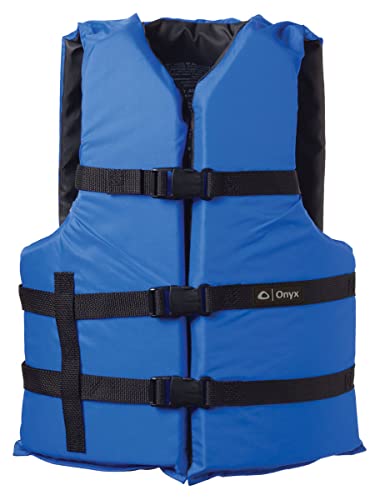
The best life jackets are the ones with the right approval rating, secure fit, freedom of movement, and flotation layout for your activity—not simply the thickest or cheapest vest. For general boating, choose an approved foam vest with a dependable adjustment system; for paddling, prioritize arm mobility and a high-back design; for children, choose a correctly sized child model with a crotch strap and head-support features; and for infrequent boat use, a properly maintained inflatable can reduce bulk but demands more inspection.
Quick picks by situation
- Best all-around boating type: A US Coast Guard-approved foam life jacket with a minimum Performance Level 70 or equivalent recreational rating, multiple waist adjustments, and high-visibility panels.
- Best for kayak and canoe paddling: A low-profile paddle vest such as the NRS Ninja or Stohlquist Fit, provided the cut fits your torso and does not ride up.
- Best for active watersports: A purpose-built impact vest from a recognized watersports brand, but only when its label confirms it is approved as a flotation device for your jurisdiction. Some wake and ski impact vests are not legal substitutes for life jackets.
- Best for offshore or rough-water boating: A properly fitted inflatable or offshore foam jacket with higher buoyancy, a crotch or leg strap, reflective material, whistle, and a light-compatible design.
- Best for children: A child-specific foam jacket with an adjustable crotch strap, grab handle, head support, and bright contrasting colors.
What the approval rating actually tells you
Approval markings should come before brand, color, or price. In the United States, newer labels commonly show a performance level rather than only the older Type I, II, III, or V terminology. A Performance Level 50, 70, 100, 150, or 275 indicates buoyancy and intended use under the relevant approval standard. The number is not a simple guarantee that the jacket will turn every unconscious wearer face-up, so read the label’s limitations.
Our top picks



As an Amazon Associate we earn from qualifying purchases at no extra cost to you. Ratings are shown as listed on Amazon.
| Rating or category | Typical buoyancy | Best suited to | Important limitation |
|---|---|---|---|
| Performance Level 50 | About 11 lb / 50 N | Specialized buoyancy aids and calm-water activities | Usually not the first choice for weak swimmers, children, or rough water |
| Performance Level 70 | About 15.7 lb / 70 N | General recreational boating and paddling | Requires a close fit; may not provide the same turning performance as higher levels |
| Performance Level 100 | About 22.5 lb / 100 N | General boating where additional flotation is useful | Bulkier than a low-profile paddle vest |
| Performance Level 150 | About 33.7 lb / 150 N | Offshore and more demanding conditions | Inflatable versions need regular inspections and armed cartridges |
| Performance Level 275 | About 61.8 lb / 275 N | Very rough offshore conditions and heavy protective clothing | Large, expensive, and generally excessive for casual inland use |
Buoyancy figures are approximate conversions from newtons to pounds-force. Labels and local regulations control. In Canada, Europe, Australia, and other regions, look for the applicable national approval mark, such as Transport Canada or CE conformity, rather than assuming a US-approved product is automatically compliant.
Head-to-head: foam versus inflatable life jackets
Foam
Closed-cell foam provides flotation immediately, without pulling a handle or relying on a gas cylinder. Foam jackets are generally the better choice for children, swimmers who may panic, frequent splash-zone use, and paddling. They also tolerate wet storage better than inflatable systems, although mildew and compression can still become problems.
The tradeoff is bulk. A recreational foam vest may weigh roughly 1 to 2.5 lb, while a compact manual inflatable may weigh around 1 to 1.5 lb before deployment and occupy far less closet space. Foam also tends to trap heat and can restrict movement if the arm openings are narrow or the torso is too short.
Inflatable
Inflatable models are comfortable in hot weather and provide excellent freedom of movement before deployment. Manual inflatables activate when the wearer pulls a handle; automatic/manual models can inflate after immersion, depending on the mechanism and conditions. They are attractive for experienced adult boaters who can swim, understand the mechanism, and will inspect the jacket before every outing.
They are a poor default for children, non-swimmers, high-impact sports, and activities where the wearer may be unconscious or unable to pull the handle. An inflatable is not ready for use if its cylinder is empty, its indicator is not green, its oral inflation tube is damaged, or its bladder has a leak. Never confuse a belt pack with a worn life jacket: it must be inflated and positioned correctly before it can provide meaningful support.
Fit systems and flotation placement matter more than appearance
A good jacket stays in position when you lift the wearer by the shoulders. Put it on over the clothing normally worn during the activity, tighten every adjustment, and perform a shore-side fit check. If the jacket rides above the ears, covers the face, or slips over the shoulders, choose a smaller size or a different cut.
- Three or more adjustment points: Separate chest, waist, and shoulder adjustments make it easier to remove looseness without crushing the ribs.
- Segmented foam panels: These improve torso flexibility and reduce pressure when sitting in a kayak or boat seat.
- High-back design: The foam rises behind the head but leaves space for a kayak seat. This is useful for paddlers and boaters with raised seat backs.
- Front-entry versus side-entry: Front zippers are convenient, while side-entry designs can provide a cleaner, less bulky front. Both can fit well if the straps are correctly positioned.
- Crotch strap: Especially important for infants and young children because it helps prevent the jacket from riding over the head.
- Grab handle: Useful for lifting a child from the water, but it is not a substitute for a secure fit.
Flotation concentrated high on the chest and around the head can support face-up positioning, while low-profile distributed foam usually feels more natural for paddling. A paddle vest that is comfortable while seated may not offer the same turning assistance as a higher-buoyancy offshore jacket. Choose based on the likely emergency, not merely on how unobtrusive the vest feels.
Comparison of common life-jacket categories
| Category | Typical weight | Mobility | Visibility | Best use |
|---|---|---|---|---|
| Child foam jacket | About 0.7–1.5 lb | Moderate | Bright colors, reflective details on better models | Children on boats, docks, and calm water |
| Low-profile paddle vest | About 1–1.8 lb | High at the shoulders and arms | Varies; add a whistle and choose bright fabric | Kayaking, canoeing, and stand-up paddleboarding |
| Recreational foam boating vest | About 1–2.5 lb | Moderate | Usually good in orange, red, or yellow versions | Fishing, cruising, and inland boating |
| Inflatable adult vest | About 1–1.5 lb | Very high before inflation | Often limited before deployment | Experienced adult boaters seeking low bulk |
| Offshore high-buoyancy jacket | About 2–4 lb | Lower, but stable in rough conditions | High-visibility shell, reflective tape, and whistle | Offshore trips and severe weather exposure |
These are typical ranges, not certification limits. Actual weight depends on size, foam density, shell fabric, hardware, and whether the jacket is inflatable.
Decision matrix: choose by user and outing
| Your situation | Most suitable choice | Why |
|---|---|---|
| First-time boater with limited budget | Approved foam recreational vest | Low maintenance, immediate flotation, typically about $25–$80 |
| Experienced paddler using a narrow kayak | Low-profile paddle vest | Better arm clearance and less interference with the seat |
| Child under 30 lb | Infant-rated foam jacket with crotch strap | Child-specific flotation placement and easier retrieval |
| Hot-weather adult boater with little storage | Approved manual or automatic/manual inflatable | Compact and cool, if inspected and worn correctly |
| Wakeboarding, waterskiing, or tubing | Approved impact-rated watersports vest | Designed for movement and impact; verify it is a legal flotation device |
| Offshore or foul-weather boating | High-buoyancy offshore jacket with leg strap | Improves stability, visibility, and retention in rough water |
Ownership: what wears out first
Inspect every jacket before use. The most common failures are frayed webbing, cracked buckles, stretched seams, compressed foam, damaged zippers, mildew, and faded or peeling reflective material. Salt, sunscreen, chlorine, and petroleum products accelerate deterioration. Rinse with fresh water, hand-wash with mild soap, air-dry completely in the shade, and store loosely in a ventilated area. Do not machine-dry, iron, bleach, or store a wet jacket in a sealed compartment.
For inflatables, check the cylinder date and size, status indicator, oral inflation valve, activation mechanism, and bladder according to the manufacturer’s schedule. A rearming kit commonly costs about $15–$40, and professional inspection or replacement may be worthwhile after deployment. Foam jackets generally have lower ongoing costs, but replacing a damaged vest is safer than trying to sew through flotation panels or repair a split shell.
As a simple ownership calculation, a $60 foam vest used 20 times per summer for five years costs about $0.60 per use before replacement. A $150 inflatable used 20 times per year for five years costs $1.50 per use before rearming kits and inspections. The inflatable may still be the better purchase if comfort makes you wear it consistently; an unworn “cheap” jacket provides no practical protection.
Bottom line
For most families, start with approved, brightly colored foam jackets in the correct adult or child size. Choose a low-profile paddle vest when shoulder mobility and kayak-seat compatibility are priorities. Choose an inflatable only when the wearer understands its limitations and will maintain it. Before buying, check the approval label, buoyancy level, weight range, chest-size range, flotation placement, adjustment points, and activity restrictions. The best life jackets are the ones that fit tightly, match the water conditions, and remain on the body for the entire outing.