Key takeaways
- Small dogs: Choose a lightweight, narrow receiver with a short, adjustable strap and controls that are hard to activate by accident. Skip bulky units that shift or press on the throat.
- Recall in an open field: A remote collar with a claimed range suited to your actual training area may help deliver a consistent cue at a distance. Range claims are measured under ideal conditions, not guaranteed working distances.
- Training near home or in a yard: A basic remote model or a long line may be more practical than paying extra for several miles of advertised range.
- Frequent swimming or wet-weather work: Look for an explicit waterproof rating for both the receiver and remote. “Water-resistant” does not necessarily mean safe to submerge.
- First-time owners: Favor simple controls, a lock feature, clear level indicators, and tone or vibration options. Get help from a qualified trainer before using static stimulation.
- Persistent barking: First investigate what triggers the barking and address that cause. An automatic correction collar may suppress a warning without teaching the dog what to do instead.
Best Dog Training Collars for Safer Training
The best dog training collars are those that fit securely, offer the range and battery life your routine needs, and let you start with low-intensity communication—usually tone or vibration—before considering any other mode. For most owners, a well-fitted vibration-and-tone collar or a long-line leash is a safer first choice than a collar that relies on static stimulation.
Quick picks by dog and training goal
- Small dogs: Choose a lightweight, narrow receiver with a short, adjustable strap and controls that are hard to activate by accident. Skip bulky units that shift or press on the throat.
- Recall in an open field: A remote collar with a claimed range suited to your actual training area may help deliver a consistent cue at a distance. Range claims are measured under ideal conditions, not guaranteed working distances.
- Training near home or in a yard: A basic remote model or a long line may be more practical than paying extra for several miles of advertised range.
- Frequent swimming or wet-weather work: Look for an explicit waterproof rating for both the receiver and remote. “Water-resistant” does not necessarily mean safe to submerge.
- First-time owners: Favor simple controls, a lock feature, clear level indicators, and tone or vibration options. Get help from a qualified trainer before using static stimulation.
- Persistent barking: First investigate what triggers the barking and address that cause. An automatic correction collar may suppress a warning without teaching the dog what to do instead.
What matters more than the advertised range
Fit comes first. The receiver should sit snugly against the side of the neck without sliding around, while still allowing comfortable breathing and swallowing. Strap adjustment matters because neck sizes vary even among dogs of similar weight. Use the maker’s neck-measurement chart rather than choosing by breed or weight alone. Check the fit regularly, especially during growth or seasonal coat changes, and follow the manufacturer’s wear-time guidance. Continuous pressure from any collar can irritate skin.
Our top picks

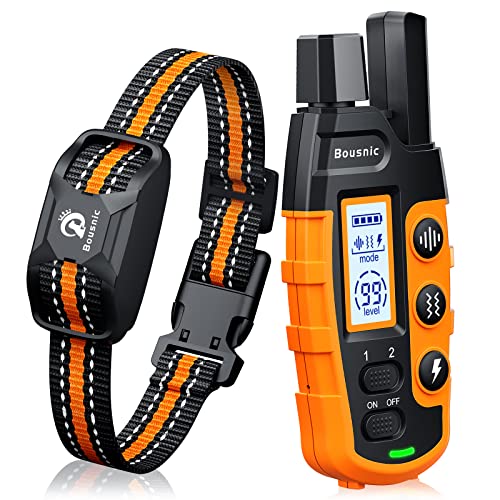


As an Amazon Associate we earn from qualifying purchases at no extra cost to you. Ratings are shown as listed on Amazon.
Range should match the setting. Buildings, trees, hills, fences, and radio interference can shorten a remote collar’s effective range. A model advertised for several miles is not a substitute for a leash or secure enclosure. Keep a dog on a lead wherever recall is not reliable or local rules require it.
Waterproofing needs a precise claim. Check whether the rating applies to the receiver, remote, and charging ports—not just one component. After use in water or mud, rinse off debris if the manual permits, dry the unit and contact points, and inspect the strap. Salt water and grit can be especially hard on hardware.
Control modes and safeguards shape everyday use. Tone and vibration can serve as cues, but neither is automatically harmless: a startling vibration may distress a sensitive dog. If a collar includes static stimulation, look for clearly displayed levels, a momentary option, a safety timeout, and a control lock. Avoid models that make it easy to deliver repeated or accidental corrections.
Comparison: example models and what their specs mean
The figures below are manufacturer-published specifications for representative products, not a ranking. Verify the current manual and product version before buying; accessories and specifications can vary by model or market.
| Product | Published range | Modes / capacity | Water rating | Best fit for |
|---|---|---|---|---|
| PetSafe 300 Yard Remote Trainer | 300 yards | Tone, vibration, and 15 static levels; one dog | Collar receiver described as waterproof; check remote limitations | Basic yard or nearby-field sessions |
| SportDOG FieldTrainer 425X | Up to 500 yards | 15 static levels, tone, and vibration; expandable to three dogs with compatible gear | Receiver and handheld remote rated waterproof/submersible by the manufacturer | Outdoor use where a rugged, expandable system is useful |
| Dogtra 280C | Up to 800 yards | Nick and continuous stimulation; one dog | Receiver and transmitter specified as waterproof | Experienced handlers who need a compact remote system |
These products include static-stimulation functions, so their inclusion is not a recommendation to use those modes. If you want to avoid static stimulation, choose a tone-and-vibration-only product and confirm that it has no static function. For a dog that is small, fearful, reactive, or uncomfortable wearing equipment, consult a qualified, reward-based trainer before introducing a remote collar.
Choose by situation, not by the biggest number
| Your situation | More suitable choice | Why |
|---|---|---|
| Short sessions in a fenced yard; limited budget | Long line, or a simple remote with modest range | More range and complexity add little if you train nearby. |
| New handler; dog already responds to food rewards | Long line and reward-based recall practice | You can build reliability while preventing rehearsal of running off. |
| Regular work across open, legally accessible land | Remote with clear controls, useful range, and adequate battery life | Terrain and line of sight matter more than the headline range. |
| Multiple dogs trained together | Expandable system with clearly distinguishable dog channels | Reduces the chance of sending a cue to the wrong receiver. |
| Swimming or wet, muddy conditions | System with explicit ratings for both handheld remote and receiver | A waterproof receiver does not guarantee a waterproof remote. |
Battery life, upkeep, and ownership costs
Battery claims usually describe expected operation under particular use conditions; frequent cueing, cold weather, and an aging battery can reduce runtime. Prefer a clear low-battery warning and a charging system you can replace or use reliably. Before a session, charge the unit, check that the remote is paired, and confirm the controls work at close range. Do not wait until a long outing to discover the battery is depleted.
Straps, charging-port covers, contact points, and remote buttons are common wear areas. Inspect the strap for cracking and the receiver for loose parts; clean only as the manual directs. Keep contact points clean and use only the supplied or approved parts. If the device causes redness, sores, or persistent discomfort, remove it and seek veterinary advice if the problem does not resolve.
Factor in more than the purchase price. General market prices vary widely by range, construction, and included accessories: basic remote systems are often around $50–$100, while more feature-rich outdoor systems may cost roughly $150–$300 or more. Replacement straps, extra receivers, and charging accessories can add to the cost. A long line is often a lower-cost way to practice recall while maintaining physical control.
A safer setup before the first session
- Check the fit and equipment. Measure the neck, secure the receiver according to its manual, and test the remote at close range.
- Teach the cue without the collar first. Pair a word or whistle with a reward in a quiet, low-distraction place. Practice until the dog responds consistently.
- Add distance gradually. Use a long line in a safe area, reward the return, and increase distractions in small steps. Do not test recall near roads, wildlife, or other hazards.
- Keep sessions brief and positive. Stop if the dog appears fearful, confused, or distressed. A collar cannot replace training, supervision, or a secure leash.
- Get help when needed. If the behavior involves aggression, fear, or sudden changes, speak with a veterinarian and a qualified behavior professional rather than trying to correct it with a collar.
A remote training collar is a piece of communication equipment, not a shortcut to reliable behavior. For many dogs and owners, a comfortable harness or flat collar, rewards, and a long line provide the clearest and safest starting point.