Key takeaways
- The best landscape lighting for yards is usually a hybrid system: low-voltage wired fixtures for paths, trees, and facades that need dependable brightness, plus solar lights for small borders, planters, and areas where trenching is impractical. Solar lighting wins on…
The best landscape lighting for yards is usually a hybrid system: low-voltage wired fixtures for paths, trees, and facades that need dependable brightness, plus solar lights for small borders, planters, and areas where trenching is impractical.
Solar lighting wins on installation cost and simplicity, while low-voltage lighting wins on brightness, runtime, beam control, and reliability. The right choice depends less on the number of fixtures than on the job each fixture must perform.
Our top picks


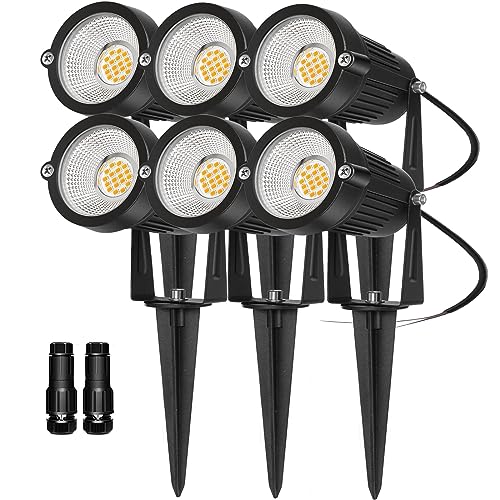
As an Amazon Associate we earn from qualifying purchases at no extra cost to you. Ratings are shown as listed on Amazon.
Solar vs. low-voltage landscape lighting
| Criterion | Solar fixture | Low-voltage wired fixture |
|---|---|---|
| Typical output | 5–80 lumens per fixture | 50–500 lumens per fixture |
| Power source | Integrated rechargeable battery and solar panel | 12-volt transformer connected to buried or surface-laid cable |
| Typical operating time | 6–12 hours after a strong sunny day; less in winter or shade | As long as the timer is programmed and power is available |
| Best use | Decorative borders, small paths, planters, remote areas | Safety paths, steps, trees, walls, driveways, and architectural lighting |
| Installation | Push into soil; no cable or transformer | Requires cable routing, connectors, fixture placement, and a transformer |
| Typical IP rating | IP44–IP65 | IP65–IP67 for outdoor-rated fixtures and connections |
| Common long-term cost | Low starting cost, but batteries and complete fixtures may need replacement | Higher initial cost, with replaceable lamps or LED modules and serviceable cable |
These are broad ranges rather than guarantees. A solar light with a large panel and lithium battery can outperform a very small decorative model, while a wired fixture’s useful coverage depends on its beam angle, mounting height, and lumen output.
Choose by the area you want to light
Paths and steps
For a walkway, use evenly spaced path lights rather than a few extremely bright fixtures. Solar path lights producing roughly 15–50 lumens can define a garden edge, but low-voltage fixtures producing 100–250 lumens are a better choice for frequently used paths, steps, and changes in elevation.
Place path lights on alternating sides instead of creating a runway with opposing fixtures directly across from one another. As a starting point, space 6–10-foot-tall path-light poles about 6–10 feet apart. Narrow paths may need less spacing; dense planting, curves, and steps may require closer placement.
Choose a hooded fixture that directs light downward. Glare from an exposed LED is more distracting than a slightly dimmer fixture with good shielding.
Trees and large shrubs
Uplighting a tree usually calls for a spotlight or well light with approximately 200–500 lumens. A narrow 15–30-degree beam can emphasize a trunk or a tall, narrow tree. A 35–60-degree beam spreads light across a broad canopy or shrub.
One fixture often covers a small ornamental tree, but a mature tree may look more natural with two or three lower-output fixtures placed around the trunk. Multiple moderate beams reveal texture from different directions and reduce the harsh shadow produced by a single bright light.
Facades, fences, and walls
For a facade, select a fixture by beam spread as well as lumens. A 100–300-lumen wall-wash or spotlight can cover a modest section of siding, brick, or stone. Wide flood optics are useful for broad walls, while narrow optics create vertical accents around columns, trees, or architectural details.
Mount or aim fixtures so the light source is not visible from seating areas or neighboring windows. Dark-sky-friendly full-shield fixtures are preferable where local rules or neighborhood concerns limit upward light.
How many fixtures do you need?
A practical coverage estimate starts with fixture spacing, not a product’s advertised “coverage” claim. For a 40-foot path using fixtures every 8 feet, divide the path length by spacing and add one fixture for the endpoint: 40 ÷ 8 + 1 = 6 fixtures. Alternating sides can produce a balanced layout with three on each side.
For a 30-foot facade, four 250-lumen fixtures spaced approximately 7–8 feet apart may provide more even coverage than two 500-lumen spotlights. The exact result depends on beam angle and mounting distance, but spreading the light usually reduces bright spots and dark gaps.
| Application | Suggested lumens per fixture | Approximate spacing or coverage | Useful beam or design |
|---|---|---|---|
| Decorative garden border | 5–25 | 4–8 feet apart | Soft, downward glow |
| Regular walkway | 50–150 | 6–10 feet apart | Shielded path light |
| Steps or driveway edge | 100–250 | Closer spacing at hazards and turns | Low-glare, downward-directed light |
| Small tree or shrub | 100–250 | One fixture for a small specimen | 15–45-degree spotlight |
| Large tree | 200–500 | Two or more fixtures as needed | Mixed narrow and wide beams |
| Wall or facade accent | 100–300 | About 6–10 feet between fixtures | Flood, wash, or adjustable spotlight |
IP ratings: what outdoor weather protection means
The IP code has two digits. The first describes protection from solids and dust; the second describes water resistance. IP44 resists objects larger than 1 millimeter and splashing water. IP65 adds dust-tight construction and protection from water jets. IP67 is dust-tight and can tolerate temporary immersion under specified conditions.
For exposed landscape fixtures, IP65 is a sensible minimum. IP67 is especially useful for in-ground well lights or fixtures installed where water collects. Solar lights with IP44 ratings can work under a roof or in a sheltered bed, but they are a weaker choice for sprinklers, heavy rain, and winter freeze-thaw cycles.
Do not evaluate the fixture alone. Cable connectors, transformer enclosures, battery compartments, and extension connections can be the first points of failure. Use outdoor-rated connectors, keep junctions out of standing water, and follow the manufacturer’s burial instructions.
A decision matrix for common yard situations
| Your situation | Best starting choice | Why |
|---|---|---|
| Small rented yard; no trenching allowed | Solar, 10–50 lumens | Portable and inexpensive to reposition |
| Frequently used walkway or steps | Low-voltage, 100–250 lumens | More consistent brightness and dependable runtime |
| Large shaded garden | Low-voltage wired system | Solar panels may not receive enough direct sunlight |
| Remote tree beyond the house | Solar spotlight or a separate wired zone | Avoids excessive cable runs |
| Regular entertaining and facade lighting | Low-voltage, 150–500 lumens | Better control, timers, aiming, and repeatable output |
| Lowest initial budget | Solar decorative fixtures | No transformer, cable, or installation labor |
Low-voltage setup: the details that prevent voltage loss
For a wired system, sketch the path from the transformer to each fixture before digging. Keep total cable length reasonable, use cable sized for the run, and divide a large installation into zones when possible. A long run with many fixtures can produce dimmer lights at the far end if the cable is undersized or overloaded.
-
Mark the path of the cable and check for buried utilities before digging.
-
Position fixtures temporarily and view them after dark before permanently securing them.
-
Connect the transformer and confirm the total wattage stays within its rated capacity.
-
Use weatherproof connectors designed for landscape cable rather than household wire nuts exposed to soil.
-
Bury or cover cable according to the product instructions, leaving enough slack to move fixtures during gardening.
-
Set a timer for the hours the yard is actually used. A dusk-to-dawn schedule may waste energy when nobody is outside.
A 150-watt transformer should not be planned around 150 watts continuously. Leaving capacity for startup variation, future fixtures, and cooler operation is sensible; a connected load around 100–120 watts gives more flexibility than running at the absolute limit.
Ownership realities: what wears out first
In solar lights, the rechargeable battery is commonly the first consumable. Battery capacity declines with charge cycles, shade, heat, and cold. A fixture that once ran 10 hours may eventually run only a few hours. Replaceable battery compartments are preferable to sealed units, although a replacement battery may not restore a cloudy or degraded solar panel.
In both systems, lenses collect dust, pollen, mineral deposits, and insect residue. Clean them several times each season with water and a soft cloth. Trim plants that block a panel or beam, straighten stakes after frost heave, and remove leaves from in-ground fixtures.
Common mistakes include choosing by maximum lumens alone, placing lights too close to windows, pointing spotlights directly at eye level, and installing path lights where lawn equipment will strike them. Warm-white light around 2,700–3,000K generally looks more natural in gardens than very cool white light, while lower brightness and shielding help limit glare.
Bottom line
Choose solar for low-cost decorative illumination, sunny borders, and locations where cable installation is the main obstacle. Choose low-voltage wired lighting for paths, steps, trees, facades, shaded yards, and any area where consistent nighttime performance matters. For many homes, the best landscape lighting for yards is not one technology: use wired fixtures for the important lighting tasks and solar units where convenience outweighs maximum brightness and control.