Key takeaways
- Joint construction: Screws, dowels, and glued joints generally offer better long-term service than staples alone. Hardware should sit flush and remain inaccessible to small fingers.
- Base width: A wide, low base is harder to tip than narrow legs. Avoid a table that rocks when gentle pressure is applied to any corner.
- Edge treatment: Rounded corners and radiused edges matter at child height. A sharp tabletop corner can be more problematic than a small cosmetic scratch.
- Chair geometry: Choose a chair with a broad seat, supportive back, and feet that remain flat on the floor. Decorative cutouts should not create pinch points.
- Surface finish: Smooth, sealed surfaces are easier to clean. Very glossy finishes can show fingerprints, while deeply textured surfaces trap paint and crumbs.
- Stated capacity: Treat the published limit as a limit, not a suggestion. Do not allow children to stand on chairs or use the table as climbing equipment.
The best kids table and chairs sets are solid-wood sets for frequent, long-term use, plastic sets for easy cleaning and flexible play, and MDF sets for a lower-cost indoor craft station—provided the seat height, weight limit, and available floor space match the child.
Our top picks


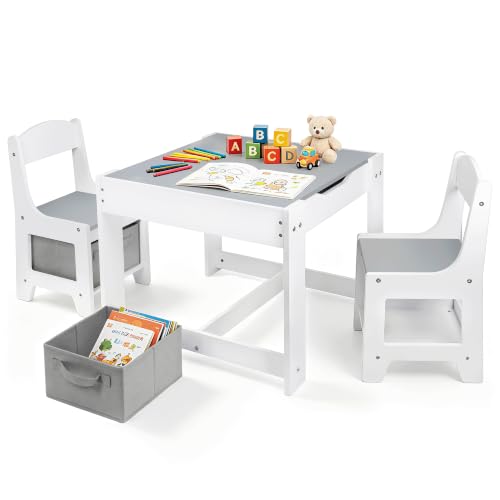
As an Amazon Associate we earn from qualifying purchases at no extra cost to you. Ratings are shown as listed on Amazon.
Quick picks by family situation
| Situation | Best choice | Useful target specifications | Why it fits |
|---|---|---|---|
| Daily crafts, homework, and meals | Solid wood | 22–24 inch table; 12–14 inch seat; 70–100 lb chair capacity | Stable, repairable, and less likely to wobble or show edge damage |
| Messy play, outdoor use, or younger toddlers | Heavy-duty molded plastic | 20–22 inch table; 10–12 inch seat; 50–80 lb chair capacity | Light enough to move and simple to wipe clean |
| Occasional indoor crafts on a budget | MDF or engineered wood | 20–24 inch table; 11–14 inch seat; 50–80 lb chair capacity | Usually costs less and offers a finished furniture look |
| Very limited room | Folding plastic or compact wood set | Table footprint under 30 by 24 inches; chairs under 15 inches wide | Can be stored against a wall or in a closet between activities |
| Several children using it for years | Oversized solid wood set | 24–30 inch table; 14–16 inch seat; 100 lb or higher chair capacity | Provides more knee room and a longer useful size range |
Solid wood vs. plastic vs. MDF
Solid wood: the best long-term investment
Solid wood is usually the strongest option for a set used every day. Beech, birch, rubberwood, pine, and similar furniture woods can withstand repeated sitting, leaning, drawing, and moving. Screwed joints can often be tightened, and minor scratches can be sanded or touched up.
Its disadvantages are weight, cost, and maintenance. A solid-wood table may weigh 25–45 pounds, making it harder for a child to move safely. Water left on an unfinished or poorly sealed surface can cause swelling, stains, or raised grain. Look for rounded corners, smooth edges, countersunk hardware, and a finish described as suitable for children’s furniture. A typical market range is about $120–$300 for a table with two chairs, depending on size and construction.
Plastic: the practical choice for mess and mobility
Molded plastic is the easiest material to clean after paint, snacks, play dough, or spilled drinks. It will not splinter, and a lightweight table can be carried outdoors or moved away quickly when floor space is needed. Thick, one-piece seats and tables are generally more stable than thin panels assembled with small fasteners.
Plastic can become brittle after prolonged outdoor sun exposure, and lightweight chairs may slide or tip when a child climbs on them. Check for broad feet, non-slip pads, a reinforced underside, and a clearly stated weight limit. Plastic sets commonly cost around $50–$180. They are particularly useful for toddlers, but a small seat can become cramped once a child reaches kindergarten age.
MDF: attractive and affordable, with a moisture warning
MDF, or medium-density fiberboard, is made from compressed wood fibers. It creates smooth painted surfaces and is often used for inexpensive indoor furniture. A well-built MDF set can be perfectly suitable for drawing, puzzles, and supervised meals.
The weak point is exposed or damaged edges. Once water reaches an unsealed edge, MDF can swell and lose strength. Do not leave wet cups, paint water, or damp cloths on the table, and wipe spills instead of soaking the surface. MDF furniture is also less forgiving if repeatedly dismantled and reassembled. Expect roughly $70–$180 for a small set, with construction quality varying widely.
Match seat height to the child, not just the age label
Age ranges on packaging are useful starting points, but children of the same age can differ considerably in height. The child should be able to sit with both feet supported, knees near a right angle, and enough space between the underside of the tabletop and the thighs. A seat that is too high encourages dangling feet and climbing; one that is too low can force the child to hunch over crafts.
| Child stage | Typical seat height | Typical table height | Practical weight-limit target |
|---|---|---|---|
| Young toddler | 9–11 inches | 17–20 inches | At least 50 lb per chair |
| Older toddler or preschooler | 11–13 inches | 20–22 inches | At least 60 lb per chair |
| Kindergarten through early grade school | 13–15 inches | 22–25 inches | At least 80 lb per chair |
| Taller grade-school child | 15–17 inches | 25–28 inches | 100 lb or more per chair |
These are selection targets rather than universal standards. Always compare them with the manufacturer’s stated dimensions and capacity. Measure from the floor to the back of the child’s knee while the child wears normal indoor clothing. For the table, allow approximately 9–12 inches between the seat surface and tabletop so legs are not compressed.
What matters more than the material label
- Joint construction: Screws, dowels, and glued joints generally offer better long-term service than staples alone. Hardware should sit flush and remain inaccessible to small fingers.
- Base width: A wide, low base is harder to tip than narrow legs. Avoid a table that rocks when gentle pressure is applied to any corner.
- Edge treatment: Rounded corners and radiused edges matter at child height. A sharp tabletop corner can be more problematic than a small cosmetic scratch.
- Chair geometry: Choose a chair with a broad seat, supportive back, and feet that remain flat on the floor. Decorative cutouts should not create pinch points.
- Surface finish: Smooth, sealed surfaces are easier to clean. Very glossy finishes can show fingerprints, while deeply textured surfaces trap paint and crumbs.
- Stated capacity: Treat the published limit as a limit, not a suggestion. Do not allow children to stand on chairs or use the table as climbing equipment.
A simple decision matrix before buying
| Priority | Choose | Avoid |
|---|---|---|
| Lowest initial price | Compact plastic or basic MDF | Oversized hardwood sets with features the child will outgrow |
| Five or more uses per week | Solid wood with replaceable or tighten-able hardware | Thin MDF edges and chairs with flexible legs |
| Storage after every use | Light plastic or a folding design with a secure locking mechanism | Heavy tables that require lifting by a child |
| Paint, water, and sensory activities | Sealed plastic or sealed wood with washable coating | Unsealed MDF and unfinished wood |
| Shared by siblings | Wide tabletop and chairs rated for the heavier child | Two-child sets with little knee or elbow room |
Ownership costs: the cheaper set is not always cheaper
Consider a $90 plastic set used twice a week for three years. That is approximately 312 uses, or about $0.29 per use before replacement parts. A $210 solid-wood set used five times a week for five years provides about 1,300 uses, or roughly $0.16 per use. This calculation does not prove that wood is better for every home: if a child outgrows the set after one year, the less expensive option may have the lower real cost.
Frequency, expected growth, and resale or hand-me-down potential matter more than the purchase price alone. Buying a table that is too large now can also create a safety and comfort problem, so avoid paying for years of capacity the child cannot use yet.
Setup and maintenance that extend the set’s life
- Assemble on a level floor. If the table is twisted during assembly, tightening all fasteners at once can lock in a wobble. Loosely fit the hardware, level the frame, then tighten gradually.
- Check every connection before use. Press each corner, inspect leg joints, and confirm that chair feet sit evenly. Repeat this check monthly for frequently used sets.
- Use mild cleaning methods. A damp cloth and mild soap are usually enough. Avoid abrasive pads that remove protective coatings, and do not saturate MDF or unfinished wood.
- Control moisture. Use a washable mat for paint and play dough, but remove it afterward so trapped moisture does not damage the surface.
- Inspect the wear points. The first failures are often loose leg hardware, chipped edge coating, sliding feet, and swollen MDF corners. Repair or retire the set when a crack, sharp edge, or unstable joint appears.
Final buying recommendation
Choose solid wood when the set will be a daily piece of furniture and you want the best chance of using it through several stages. Choose plastic when cleanup, portability, and outdoor flexibility matter most. Choose MDF when the set will remain indoors for occasional activities and the edges are thoroughly sealed. In every case, prioritize a correctly sized seat, a stable base, a clearly stated weight limit, and enough tabletop space for the child’s actual activities.