Key takeaways
- New construction or a major remodel: Choose a complete, heavy-gauge door and frame system with an inward swing if the room layout allows it. The builder can reinforce the surrounding structure and set the rough opening to the manufacturer’s dimensions before finishes go in.
- Existing room with limited access: Favor a model whose frame and delivery plan suit the route into the house. A very heavy door may require special handling, and a finished opening may need structural work before the frame can be secured.
- Frequent access: Look for a mechanical or electronic UL-listed lock with a documented relocking feature, plus a usable interior release where required by local code. Confirm how the door can be opened from inside with the selected lock configuration.
- Fire protection is essential: Buy a door with a stated fire rating for the complete assembly and ask what standard, test, and installation conditions support it. A thick steel plate alone is not a fire rating.
- Maximum burglary resistance is the priority: Compare independently documented assembly-level ratings and installation requirements. Do not equate steel thickness, marketing language such as “vault,” or a lock’s UL listing with a rated door.
Best High-End Reinforced Safe Room and Vault Doors
The best high-end reinforced safe room door is the one whose tested security rating, swing, frame, and anchoring plan match the actual wall opening—not simply the one with the thickest steel. For a residential installation, prioritize a complete door-and-frame assembly with documented burglary-resistance performance, a reputable UL-listed lock, and a clear installation drawing; treat fire resistance as a separate, independently verified requirement.
Best choice by installation situation
- New construction or a major remodel: Choose a complete, heavy-gauge door and frame system with an inward swing if the room layout allows it. The builder can reinforce the surrounding structure and set the rough opening to the manufacturer’s dimensions before finishes go in.
- Existing room with limited access: Favor a model whose frame and delivery plan suit the route into the house. A very heavy door may require special handling, and a finished opening may need structural work before the frame can be secured.
- Frequent access: Look for a mechanical or electronic UL-listed lock with a documented relocking feature, plus a usable interior release where required by local code. Confirm how the door can be opened from inside with the selected lock configuration.
- Fire protection is essential: Buy a door with a stated fire rating for the complete assembly and ask what standard, test, and installation conditions support it. A thick steel plate alone is not a fire rating.
- Maximum burglary resistance is the priority: Compare independently documented assembly-level ratings and installation requirements. Do not equate steel thickness, marketing language such as “vault,” or a lock’s UL listing with a rated door.
What to compare before choosing
| Decision point | What to verify | Why it matters at home |
|---|---|---|
| Door construction | Ask for face-sheet thickness, core construction, frame gauge, and whether figures describe one plate or the full assembly. Steel gauge numbers run in reverse: a lower gauge generally means thicker steel. | A thick face does not reveal the strength of the frame, hinge side, lock area, or wall attachment. |
| Burglary rating | Request the exact test standard, rating level, and certificate for the door-and-frame assembly. Check whether the rating depends on a specific wall or installation method. | A lock certification is not a burglary rating for the entire door. |
| Lock | Confirm the exact lock model and UL listing, such as a listing under the applicable UL 768 category for combination locks. Ask about relockers, keypad power, battery replacement, and emergency procedures. | Certification applies to the specified lock and use; it does not certify the surrounding steelwork. |
| Fire performance | Get the rating duration, test standard, label or listing information, and conditions for frame, seals, hardware, and installation. | Fire ratings are assembly-specific. Unrated substitutions or field modifications can undermine the claimed performance. |
| Swing and clearance | Confirm hinge side, swing direction, clear opening, handle projection, and any interior release or emergency-egress requirements. | An inward-swing door can be harder to force from the corridor, but may be blocked by stored contents or debris. The right choice depends on the room and applicable code. |
| Opening and anchors | Use the manufacturer’s rough-opening drawing, frame dimensions, anchor type and spacing, substrate requirements, and minimum concrete or masonry details. | Anchoring a heavy frame into drywall, weak block, or an inadequately reinforced wall can defeat the purpose of a premium door. |
Steel thickness, ratings, and the limits of a spec sheet
Ask sellers to state thickness in inches or millimeters as well as gauge, and clarify whether the number refers to the door skin, internal plate, or frame. For reference, 12-gauge sheet steel is roughly 0.105 inch (2.7 mm) thick and 10-gauge is roughly 0.135 inch (3.4 mm); actual finished products can vary by material and manufacturing tolerance. Those figures are comparison points, not a shortcut for predicting resistance.
Our top picks


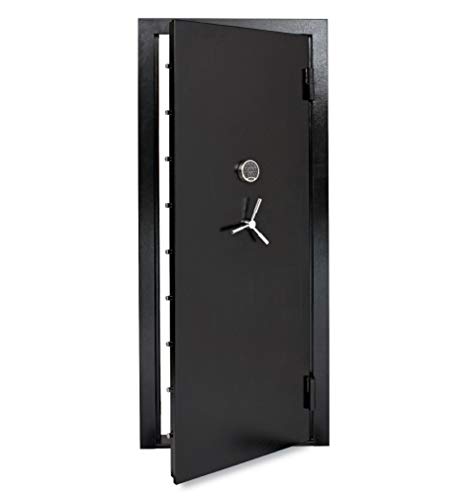
As an Amazon Associate we earn from qualifying purchases at no extra cost to you. Ratings are shown as listed on Amazon.
Security depends on how the door, boltwork, hinges, frame, anchors, and surrounding wall work together. A robust leaf in a weak frame or lightly built partition is a poor system. Ask for drawings and independent documentation rather than relying on descriptions such as “reinforced,” “commercial grade,” or “vault quality.”
Likewise, distinguish a UL-listed lock from a UL-rated door. A lock listing tells you about the specified lock under its applicable standard; it does not establish that the complete opening has a particular burglary resistance. If a salesperson quotes a rating, request the exact certificate and confirm that the model, size, lock, frame, and installation match it.
Rough opening, swing, and anchoring: plan before ordering
Do not order by nominal door size alone. The rough opening is the framed or masonry opening before the finished frame is installed; it is not necessarily the door leaf size or the clear walk-through width. Obtain the current manufacturer drawing for the exact model and handing, then have the installer measure the opening at several points for width, height, plumb, and squareness.
- Map the route and the room. Measure the delivery path, turns, stairways, floor capacity, and clearance for the door’s full swing. A heavy leaf may arrive separately from its frame, but confirm this with the manufacturer.
- Choose handing and swing before framing. Check whether the door can be opened from inside, whether shelves or stored items could obstruct it, and whether local building or fire rules affect the choice.
- Match the wall to the frame. Have a qualified contractor verify that the wall construction and reinforcement can accept the specified anchors. Concrete, reinforced masonry, and framed walls require different attachment strategies; never assume the supplied anchors suit every substrate.
- Install to the drawing. Follow required anchor locations, embedment, fastener type, shimming, and frame tolerances. Do not cut or drill rated components unless the manufacturer explicitly permits it.
- Test before loading the room. Cycle the door and lock several times, check consistent bolt engagement, and confirm the inside release. Correct binding or misalignment before storing valuables.
Budget and ownership realities
High-end reinforced door systems commonly cost several thousand dollars, with custom sizes, certified assemblies, specialized locks, delivery, structural work, and installation pushing totals higher. Treat broad market quotes as starting points rather than comparable offers: request an itemized price for the door, frame, lock, freight, rigging, installation, and any wall modification.
Before purchase, ask who services the lock, whether replacement parts remain available, and how to obtain access if an electronic lock’s batteries fail. Keep the lock documentation and emergency procedure somewhere accessible outside the secured room. Use only manufacturer-approved lubricants and cleaning methods; abrasive cleaners or improvised lubrication can damage finishes or interfere with boltwork.
Over time, alignment and moving hardware deserve attention. Watch for a door that rubs, a handle that becomes harder to operate, inconsistent bolt travel, or a keypad that gives low-battery warnings. Avoid hanging extra weight from the handle, forcing a misaligned bolt, or storing objects where they can block the swing or interior release. Arrange service through the manufacturer or a qualified safe technician rather than adjusting a heavy door or lock by guesswork.
Bottom line
For a residential safe room, prioritize a documented complete assembly, an appropriately UL-listed lock, a verified fire rating if needed, and installation details that suit the actual wall. The strongest practical choice is not necessarily the thickest door: it is the system whose frame, anchors, swing, opening, and service plan can all be installed correctly in your home. Get the model-specific drawings and written rating documentation before construction or ordering.