Key takeaways
- Wipe shafts and tips after use, particularly after contact with oils, moisture, or debris.
- Keep precision bits in their holder; bent or chipped tips are poor candidates for small fasteners.
- Use hand force appropriate to the screw. A driver is not a substitute for a torque-limited tool on delicate assemblies.
- Inspect the screw head as well as the driver. A damaged fastener can make a good tip slip.
- Do not assume a kit includes every bit shown in a family’s broader range; verify the exact contents.
Best Felo Screwdrivers for Precision Repairs
The best Felo screwdrivers for precision repairs are the E-SMART interchangeable set for a compact, versatile kit; the ESD-safe MICRO set for electronics; and individual Felo Ergonic drivers when you need a dedicated handle and longer reach. Choose by screw size, access, and frequency of use—not by handle style alone. Felo’s handle ergonomics are a strong point, but fit between tip and fastener matters more than magnet strength or brand when you want to avoid damaging small screws.
Which Felo screwdriver fits your situation?
| Repair situation | Best fit | Why it suits the job | Trade-off |
|---|---|---|---|
| Occasional household repairs, limited drawer space | Felo E-SMART interchangeable set | One handle serves multiple bits; compact storage keeps the kit together | Changing tips takes longer than picking up a dedicated driver |
| Small electronics and delicate screws | Felo MICRO precision set; choose an ESD-safe version for sensitive electronics | Fine tips and slim handles give better control at low torque | Small handles are tiring for larger or tight fasteners |
| Frequent repair work across several screw sizes | Felo Ergonic drivers in the sizes you use most | Dedicated shafts are ready to use and the shaped handle supports repeated turning | A full range takes more space and costs more than a small bit set |
| Recessed screws or limited clearance | A Felo driver with a shaft length matched to the recess | Reach can matter more than having additional tip styles | A long shaft is less convenient in cramped spaces and may flex more under force |
Set contents and dimensions can vary by market and by kit revision. Check the current product listing for the exact tip assortment, shaft lengths, and whether a case or holder is included before buying.
Our top picks
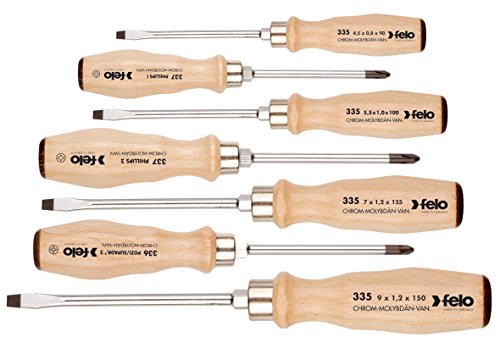


As an Amazon Associate we earn from qualifying purchases at no extra cost to you. Ratings are shown as listed on Amazon.
Ergonomics, steel, and tip fit
Handle feel: Ergonic versus precision handles
Felo’s Ergonic handle is shaped to fill the hand and provide leverage for general repair work. That is useful when a screw is snug, but leverage can also make it easy to apply too much torque to a small fastener. For electronics, the narrower MICRO-style handle encourages fingertip control. It is less suited to stubborn screws, where a larger grip is more comfortable.
For a mixed repair kit, favor the handle you can control at low force. A soft, comfortable grip cannot compensate for a poorly fitting tip or a stripped screw head.
Bit steel and tip precision
Felo drivers are commonly specified with hardened tool steel shafts, but the exact alloy and treatment can differ across product families. For routine hand repairs, careful tip geometry and correct sizing are more important than choosing a driver by a broad “hard steel” claim. Precision tips need a close fit: a Phillips tip that is too small can cam out, while a flat blade that is too narrow can slip and damage the slot.
Before turning, seat the tip fully and keep the driver aligned with the screw axis. If it rocks or contacts only at the edges, stop and try the next size or the correct drive type. Do not use a precision driver as a pry tool or substitute a Phillips driver for a Pozidriv screw.
Interchangeable set or individual drivers?
The E-SMART system is the practical pick when portability and range matter more than speed. A shared handle reduces clutter, and replacing a worn or missing bit can be less expensive than replacing a complete driver. The compromise is a changeover step, plus the need to keep the handle and bits together. If you repeatedly switch between two sizes during a job, dedicated Ergonic drivers are more convenient.
For delicate work, select a MICRO set with the exact drive types and sizes your repairs require. An ESD-safe version is worth considering when working on components that can be damaged by electrostatic discharge; it does not make a repair safe by itself. Follow the equipment maker’s precautions and disconnect power where appropriate.
Shaft length and magnetic strength: what matters in practice
A longer shaft can reach a screw deep in a housing or behind an obstruction. A short shaft is easier to control in tight spaces and generally gives a more direct feel. Avoid using extra length as a way to apply more force: greater leverage or shaft flex can make a delicate fastener harder to control. For a first kit, a useful combination is a standard-length driver for everyday access plus a longer driver only for a known recessed screw.
Magnetized tips help retain a loose screw during positioning, especially when working vertically. They do not hold every screw securely, and magnetism is not a substitute for a properly seated tip. If you work around magnet-sensitive parts, check the equipment requirements and use a non-magnetized driver where needed. Magnetic strength is rarely the deciding factor for a general-purpose kit.
Storage, upkeep, and ownership costs
Interchangeable sets are easiest to live with when each bit has a labeled slot and the handle has a fixed place in the case. A loose collection of precision bits is easy to misplace and can leave tips knocking against one another. Dedicated drivers need more drawer space, but are quicker to grab and less likely to lose a working tip during a repair.
- Wipe shafts and tips after use, particularly after contact with oils, moisture, or debris.
- Keep precision bits in their holder; bent or chipped tips are poor candidates for small fasteners.
- Use hand force appropriate to the screw. A driver is not a substitute for a torque-limited tool on delicate assemblies.
- Inspect the screw head as well as the driver. A damaged fastener can make a good tip slip.
- Do not assume a kit includes every bit shown in a family’s broader range; verify the exact contents.
In ordinary use, the tip is the part most likely to show wear first, especially if it is used on the wrong size, at an angle, or as a lever. With an interchangeable set, that wear may mean replacing one bit; with a dedicated driver, replacement means buying a complete tool. A dedicated set can still be better value if it saves time every day.
Final picks
Best all-round compact choice: Felo E-SMART, for people who want several driver options without storing a full row of handles. Best for delicate electronics: a Felo MICRO set, with an ESD-safe version when the work calls for it. Best for frequent general repairs: individual Ergonic drivers in the sizes and shaft lengths you reach for most often.
Prioritize the right tip sizes and drive types, then choose handle and storage style. That order helps avoid paying for a large set whose bits do not match your repairs—and reduces the chance of damaging fasteners through poor fit.