Key takeaways
- Check flow weekly: A noticeable drop is an early sign that mechanical media or intake protection needs attention.
- Clean mechanical media as needed: Rinse reusable sponges in removed aquarium water, rather than chlorinated tap water, to limit harm to beneficial bacteria.
- Preserve biological media: Clean it gently and avoid replacing all of it at once. Sudden loss of established bacteria can destabilize filtration.
- Inspect the impeller and seals during servicing: Clear debris, check for wear, and make sure the head closes evenly.
- Restart carefully: Re-prime according to the manual, confirm steady flow, and inspect the canister and hose connections for leaks.
Best Aquarium Canister Filters: Quick Picks by Setup
The best aquarium canister filters are the Fluval 407 for a quiet, versatile freshwater setup, the Fluval FX4 for a large or heavily stocked tank, and the Eheim Classic 2217 for a simpler design with generous biological-media capacity. For saltwater, choose a model with flow suited to the tank and livestock, then use media appropriate to the system; no canister filter replaces a protein skimmer or regular water changes.
Filter choice is less about buying the highest advertised gallons-per-hour (GPH) number and more about matching usable flow, media space, and maintenance to your aquarium. The figures below are manufacturer-listed specifications; actual flow can be lower once media, hose routing, and dirt reduce throughput. Check current model specifications before purchasing, since ratings and included media can vary by region.
Our top picks

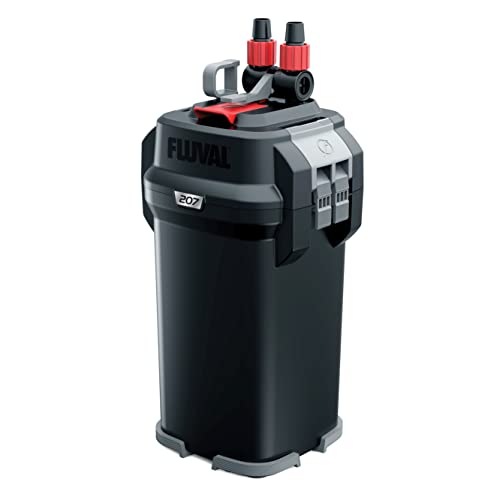


As an Amazon Associate we earn from qualifying purchases at no extra cost to you. Ratings are shown as listed on Amazon.
Head-to-Head: Size, Flow, and Media Capacity
| Filter | Manufacturer tank-size guidance | Rated flow | Media volume | Best fit |
|---|---|---|---|---|
| Fluval 107 | Up to 30 US gal | 145 US GPH pump output | 2.0 L | Small freshwater tanks where cabinet space is limited |
| Fluval 307 | Up to 70 US gal | 303 US GPH pump output | 7.3 L | Medium freshwater tanks needing flexible media stages |
| Fluval 407 | Up to 100 US gal | 383 US GPH pump output | 9.2 L | Quiet, adaptable filtration for larger community tanks |
| Fluval FX4 | Up to 250 US gal | 700 US GPH pump output | 14 L | Large tanks, messy fish, or owners who want substantial media space |
| Eheim Classic 2217 | Up to 159 US gal | 264 US GPH pump output | 6 L | Experienced keepers comfortable assembling media layers and hoses |
Tank-size recommendations are starting points, not guarantees. Stocking density, fish waste, plants, feeding, and desired circulation all matter. Pump output is not the same as delivered flow through a loaded filter, and turnover alone does not tell you whether the tank has adequate biological filtration.
Which One Should You Choose?
Best all-around: Fluval 407
The 407 balances a sizeable 9.2-liter media volume with a 383-GPH pump rating and a manufacturer capacity rating of up to 100 gallons. Its staged baskets make it easy to dedicate space to mechanical, biological, and chemical media. It is a practical choice for a stocked freshwater community tank when you want room to customize without moving to an oversized filter. For small fish or low-flow species, use the output control or diffuse the return with a spray bar.
Best for large or messy-fish tanks: Fluval FX4
The FX4 offers 14 liters of media volume and a 700-GPH pump rating, making it the strongest choice here for large aquariums or high-waste occupants such as large cichlids. Its capacity gives you room for substantial mechanical and biological media, but the canister is bulky and needs a sturdy, accessible location below the tank. A powerful return may also create too much current for some fish, so plan how to spread or reduce the flow.
Best compact pick: Fluval 107
For a smaller aquarium, the 107’s 2-liter media capacity and 145-GPH pump output avoid the footprint of a large canister. It suits modest freshwater setups within its rated range, especially when a hang-on-back filter is undesirable. Its smaller media volume means less room for customization and more sensitivity to neglected cleaning, so it is not the right upgrade for an overstocked tank.
Best for a straightforward, serviceable design: Eheim Classic 2217
The Classic 2217 has a simple canister layout, a 6-liter volume, and a 264-GPH rated flow. It can be a good fit for keepers who prefer a traditional design and are comfortable arranging the media themselves. Unlike a basket-based layout, layering and securing media takes more care; follow the model’s instructions to prevent bypass or poor flow. Confirm the tank’s actual needs rather than relying only on its large manufacturer capacity rating.
Size the Filter to the Actual Tank
A useful first check is nominal turnover: divide rated flow by aquarium volume. For a 75-gallon tank, the Fluval 407’s 383 GPH gives 383 ÷ 75 = about 5.1 turnovers per hour before accounting for flow loss. This is a screening calculation, not a target that suits every aquarium. A planted tank with gentle-flow fish may need a different return arrangement than a tank with large, waste-producing fish.
When comparing two models, consider three things together: the manufacturer’s tank guidance, media volume, and whether you can achieve even circulation without stressing livestock. If the aquarium is heavily stocked, a larger filter or a second filtration method can provide more capacity and redundancy. If the tank is lightly stocked, buying an oversized unit can add cost and maintenance without solving a real problem.
Freshwater vs. Saltwater: What Changes?
In freshwater, canisters commonly handle mechanical and biological filtration, with chemical media added when there is a specific reason. In saltwater, a canister can polish water or hold targeted media, but trapped detritus can break down into unwanted nutrients if maintenance slips. Use it as one part of a broader system, alongside appropriate circulation, live rock or other biological filtration, and—where the setup calls for it—a protein skimmer.
For either type of aquarium, do not pack every basket tightly with fine media: restricted flow can reduce performance. Use coarse mechanical media to catch larger debris, biological media for beneficial bacteria, and chemical media selectively. Carbon is consumable and should be replaced according to its intended use and the manufacturer’s directions, not treated as permanent biological media.
Noise, Installation, and Ownership Costs
A properly installed canister should generally make little more than a low motor hum and water movement. Rattling, grinding, or a sudden change in sound may point to trapped air, a dirty impeller, a loose hose, or a canister that is not seated level. Noise sensitivity makes location important: leave ventilation around the unit, keep it on a stable surface, and avoid placing it where hose vibration can touch cabinet panels.
Expect ongoing costs for replacement seals, impeller parts when needed, and consumable media. Prices vary by retailer, region, and kit contents; as a broad market guide, compact canisters often fall around $100–$200, mid-size models around $150–$300, and large high-capacity units around $250–$450 or more. Replacement media and parts add to lifetime cost, so check local availability before choosing a less common model.
The parts most likely to need attention are seals and O-rings, hoses, and the impeller assembly. Keep seals clean and lightly lubricated only with aquarium-safe products recommended for the filter. Avoid twisting hoses sharply or forcing the lid closed, and keep spare seals if a leak would be costly. Never run the unit dry; prime it as directed and check connections for leaks after servicing.
Maintenance That Protects Flow and Beneficial Bacteria
- Check flow weekly: A noticeable drop is an early sign that mechanical media or intake protection needs attention.
- Clean mechanical media as needed: Rinse reusable sponges in removed aquarium water, rather than chlorinated tap water, to limit harm to beneficial bacteria.
- Preserve biological media: Clean it gently and avoid replacing all of it at once. Sudden loss of established bacteria can destabilize filtration.
- Inspect the impeller and seals during servicing: Clear debris, check for wear, and make sure the head closes evenly.
- Restart carefully: Re-prime according to the manual, confirm steady flow, and inspect the canister and hose connections for leaks.
For most buyers, the 407 is the balanced choice, the FX4 is the large-tank workhorse, and the 107 is the compact option. Choose the Eheim Classic 2217 if its simple layout suits your maintenance habits. In every case, match the filter to stocking and flow needs—not just the biggest number on the box.