Key takeaways
- Compact tables: approximately 0.5 to 1.0 amp blowers are common and adequate for casual play.
- Mid-size tables: approximately 1.0 to 1.5 amps usually provide a more even cushion.
- Full-size recreational tables: approximately 1.5 to 2.5 amps can support faster, more consistent play.
- Commercial-style tables: often use higher-output blowers and larger air-distribution systems, but exact performance depends on the hole pattern and playing surface.
The best air hockey tables for family game rooms are usually 6- to 7.5-foot tables with a full-size playing surface, strong distributed airflow, a rigid cabinet, and enough clearance for players to move safely around both ends.
Our top picks


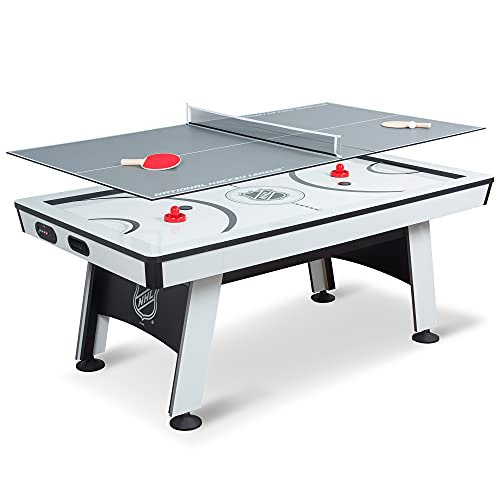
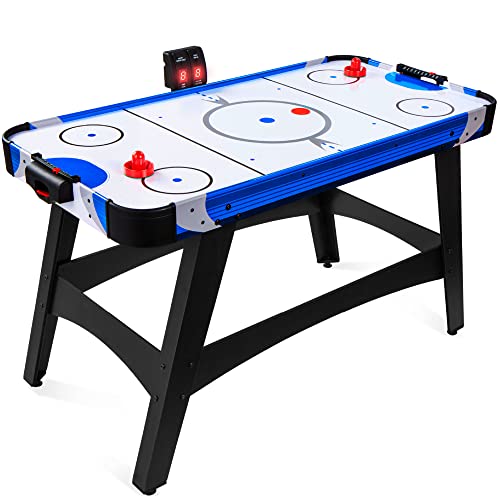
As an Amazon Associate we earn from qualifying purchases at no extra cost to you. Ratings are shown as listed on Amazon.
Quick picks by room and playing style
| Best for | Recommended table type | Typical size | Typical market range | Why it fits |
|---|---|---|---|---|
| Small family room | Compact table with electronic scoring | 5 to 6 feet long | $180–$400 | Uses less floor space while retaining a genuine air-cushion surface |
| Frequent family play | Mid-size table with reinforced cabinet | 6 to 7 feet long | $350–$750 | Balances durability, rebound quality, and reasonable assembly |
| Teenagers and adults | Full-size recreational table | 7.5 to 8 feet long | $700–$1,500 | Provides longer rallies and more room for defensive positioning |
| Serious practice | Tournament-style table | 8 feet long | $1,500–$3,500+ | Offers heavier construction, consistent airflow, and predictable rebounds |
What matters more than the listed length
Table length is only one part of the space calculation. A 6-foot table may occupy approximately 72 inches by 36 inches, but players need room to stand at either end and move their arms freely. Allow at least 36 inches beyond each end and 24 to 30 inches along each side. That creates a practical footprint of roughly 12 feet 6 inches by 7 feet for a compact table.
For an 8-foot table measuring about 96 by 48 inches, a more comfortable play area is approximately 15 feet by 8 feet. Measure the usable floor area rather than the entire room, accounting for sofas, doors, radiators, shelving, and low-hanging light fixtures.
Small rooms: choose a 5- or 6-foot table
A compact table is the sensible choice when the game room is shared with a sofa bed, pool table, exercise equipment, or a children’s play area. These models generally use a thinner cabinet and lighter legs, so they are easier to move but more sensitive to uneven floors. Look for adjustable leg levelers, a blower with multiple air outlets, and side rails that are firmly attached to the playing surface.
Tables such as the Hathaway Face-Off and similar 6-foot recreational models are aimed at this use. They are better suited to casual family games than to high-speed adult competition, but their smaller footprint can mean more frequent use because the table does not need to dominate the room.
Medium rooms: choose a reinforced 6- or 7-foot table
For families who play several times per week, a mid-size table is often the best value. It provides enough surface for meaningful rallies without requiring the room needed by a commercial table. Prioritize a laminated MDF or engineered-wood cabinet at least about 1 inch thick, cross-braced legs, and a blower that distributes air across the playing field instead of concentrating it near one end.
The Triumph Lumen-X is an example of the family-oriented feature set found in this category: electronic scoring, lighting effects, and a recreational cabinet. Features such as LED effects are enjoyable, but they should come after airflow, stability, and levelers in the buying decision.
Large rooms: choose a 7.5- or 8-foot table
A full-size table makes more sense when adults and older children will play regularly and the room has generous clearance. The longer surface gives players more time to react and makes bank shots less cramped. The trade-off is weight: a large table can weigh well over 200 pounds, making delivery, assembly, and future relocation considerably harder.
Higher-end recreational tables, including models in the Atomic Top Shelf range, commonly use thicker cabinets, stronger leg assemblies, and larger blowers than entry-level tables. They are still not automatically equivalent to a commercial tournament table, so inspect the airflow pattern and frame rigidity rather than judging quality by appearance alone.
Airflow power: the specification buyers often overlook
The blower creates the thin air cushion that allows the puck to glide. A table can have a glossy finish and impressive scoring electronics yet play poorly if air holes are blocked, unevenly spaced, or supplied by an underpowered fan.
- Compact tables: approximately 0.5 to 1.0 amp blowers are common and adequate for casual play.
- Mid-size tables: approximately 1.0 to 1.5 amps usually provide a more even cushion.
- Full-size recreational tables: approximately 1.5 to 2.5 amps can support faster, more consistent play.
- Commercial-style tables: often use higher-output blowers and larger air-distribution systems, but exact performance depends on the hole pattern and playing surface.
Amperage is not a universal performance rating, so it should not be used alone. A well-designed 1.2-amp system can feel better than a poorly distributed 2-amp system. If possible, look for photographs or documentation showing a perforated playfield across the entire surface, not only near the centerline.
Build materials and the parts most likely to wear
Most family tables use MDF or particleboard with a laminate playing surface. MDF offers a smooth, consistent substrate, while thicker panels resist flexing and sagging. Solid wood is uncommon in affordable air hockey tables and is not automatically preferable; the playing surface still needs a smooth, low-friction laminate and accurately drilled air holes.
- Playing surface: check for a durable laminate that can tolerate repeated puck impacts and routine cleaning.
- Side rails: rigid rails produce more predictable rebounds; thin rails can loosen or develop dead spots.
- Legs: wide feet and threaded levelers matter more than decorative styling.
- Blower: listen for rattling or scraping during operation; dust buildup and loose mounting hardware are common causes.
- Pucks and paddles: these are consumables. Keep spare pucks in the correct diameter and weight range for the table.
- Scoring system: electronic sensors and display modules add convenience but also add components that can eventually fail.
Do not use abrasive cleaners, silicone spray, furniture polish, or household oils on the playing surface. They can leave residue that changes puck speed and may migrate into air holes. A dry microfiber cloth is usually sufficient; use a slightly damp cloth only when the manufacturer permits it, and keep liquid away from the blower and electronics.
Assembly difficulty and the cost of getting it wrong
Compact tables may require 30 to 60 minutes of assembly, while larger tables commonly take two adults one to three hours. A full-size cabinet can be awkward even when the instructions are clear, because it must be turned over without stressing the legs or scoring electronics.
The most important assembly step is leveling. Place the table on its permanent floor position, turn on the blower, and use a long spirit level in several directions. Adjust each leg gradually rather than forcing one corner upward. A table that is only a few millimeters out of level can make the puck consistently drift toward one goal.
Budget for practical extras: a second adult for lifting, a socket set, a long level, and enough space to unpack the cabinet without bending or twisting it. If delivery includes room-of-choice or assembly service, it can be worthwhile for heavy 7.5- and 8-foot tables.
Decision matrix: which table fits your household?
| Your situation | Best choice | Prioritize | Avoid |
|---|---|---|---|
| Children under 10 and occasional play | 5- to 6-foot recreational table | Stable legs, rounded corners, accessible controls | Overspending on tournament features |
| Family uses it several times weekly | 6- to 7-foot reinforced table | Even airflow, strong rails, replaceable pucks | Very lightweight cabinets that slide during play |
| Adults and experienced teenagers | 7.5- to 8-foot table | Heavy frame, powerful blower, accurate leveling | Choosing by LED effects alone |
| Limited storage or frequent room changes | Compact table with manageable weight | Carry handles, folding or detachable legs | Commercial-weight construction |
| Dedicated game room and long-term ownership | Commercial-style 8-foot table | Serviceable blower, thick cabinet, replaceable components | Models with no parts or support information |
How to keep an air hockey table playing well
- Clear the surface before every session. Dust and hair can block air holes and slow the puck.
- Inspect the rails and legs monthly. Tighten loose fasteners before movement causes larger alignment problems.
- Clean the air holes gently. Follow the manual; compressed air may push debris deeper into the blower system on some designs.
- Replace damaged pucks and worn paddles. A cracked puck can catch on the surface and may damage the laminate.
- Cover the table when not in use. A fitted cover limits dust, sunlight, and accidental scratches.
For most families, the best air hockey tables for family game rooms are not the cheapest compact models or the largest commercial tables. A well-leveled 6- to 7-foot table with reliable airflow, reinforced rails, and a cabinet that the room can comfortably accommodate delivers the strongest balance of play quality, durability, and everyday convenience.