Key takeaways
- For weight accuracy: Withings, Garmin, Eufy, and Renpho can all be useful when placed correctly and used within their stated capacity.
- For body-fat trends: Withings and Garmin offer stronger long-term presentation, while Eufy and Renpho provide good value if the user follows a consistent routine.
- For clinical decisions: Do not use any consumer BIA scale alone to diagnose a condition or make major changes to medication, nutrition, or training. Discuss concerning results with a qualified professional.
The best smart body composition scales for accurate at-home tracking are Withings Body Smart for the strongest all-round experience, Garmin Index S2 for Garmin users, and Eufy Smart Scale P2 Pro for the most metrics at a lower typical price. The important qualification is that every consumer scale estimates body fat and muscle mass through bioelectrical impedance analysis (BIA), so repeatable conditions matter more than a single impressive percentage.
Our top picks


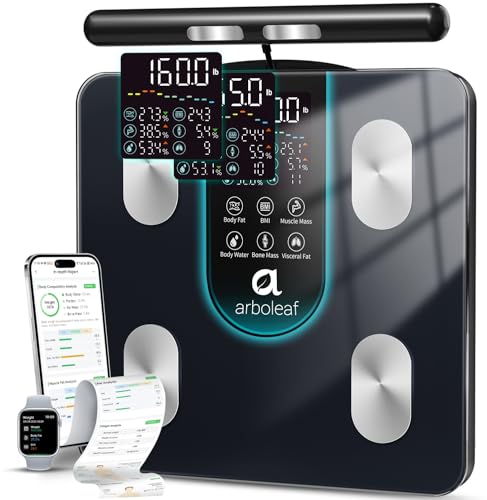
As an Amazon Associate we earn from qualifying purchases at no extra cost to you. Ratings are shown as listed on Amazon.
Quick comparison: the leading choices in 2026
| Scale | Typical price range | Maximum user weight | Approximate size | Power and battery life | Best for |
|---|---|---|---|---|---|
| Withings Body Smart | $90–$110 | 440 lb / 200 kg | 12.8 × 12.8 in; about 5.3 lb | 4 AAA batteries; up to about 15 months, depending on use | Most households and clearer trend tracking |
| Garmin Index S2 | $120–$150 | 400 lb / 181.4 kg | 12.6 × 12.2 in; about 4.4 lb | 4 AAA batteries; up to about 9 months | Garmin Connect users and athletes |
| Eufy Smart Scale P2 Pro | $50–$80 | 400 lb / 180 kg | About 11.0 × 11.0 in; about 4.1 lb | 4 AAA batteries; commonly several months per set | Metric-heavy tracking on a budget |
| Renpho smart scale models | $25–$50 | Commonly 396 lb / 180 kg | Usually about 11.0 × 11.0 in | Usually 3 AAA batteries; typically several months | Basic weight trends and low upfront cost |
Dimensions, battery life, supported measurements, and weight limits can vary by regional model and software version. Treat the table as a buying guide rather than a substitute for the specifications on the exact package.
Best overall: Withings Body Smart
Withings Body Smart is the strongest choice for most people who want a scale that is easy to share, relatively polished to use, and useful beyond daily weight readings. It measures weight, BMI, body fat percentage, water percentage, muscle mass, bone mass, visceral fat index, and basal metabolic rate estimates. Its Wi-Fi and Bluetooth synchronization can reduce the need to open the phone immediately after every weigh-in.
The main advantage is not that its body-composition estimate is medically precise. It is the combination of automatic data transfer, multiple user recognition, clear trend views, and a broad set of measurements. The Withings app also makes it easier to view longer-term direction instead of reacting to one unusually high or low result.
It is a particularly good fit for a family or shared home. The 440-pound capacity is among the more generous options in this group, and the platform is large enough for most adults. If you only need weight and want the lowest possible cost, it is more scale than necessary.
Best for Garmin users: Garmin Index S2
Garmin Index S2 makes the most sense when Garmin Connect is already the center of your training data. Weight, body fat percentage, skeletal muscle mass, body water, bone mass, and BMI can be viewed alongside activity and training information in the same ecosystem.
Its advantage is continuity rather than a uniquely superior BIA sensor. A runner or strength trainee who already uses Garmin devices can avoid maintaining a separate health dashboard. The scale supports multiple profiles and can show trend information on its color display, which is convenient when you do not want to reach for a phone.
Choose it over Withings when Garmin integration matters more than the broader household-oriented features. It is less compelling if you do not use Garmin Connect, because the higher typical price buys little benefit from the ecosystem alone.
Best budget metric selection: Eufy Smart Scale P2 Pro
The Eufy Smart Scale P2 Pro is a strong value pick for buyers who want body-fat and muscle estimates, heart-rate readings during the measurement, and a large set of app-tracked metrics without moving into premium pricing. It supports Wi-Fi and Bluetooth on compatible configurations and can accommodate multiple profiles.
The scale is comparatively compact, which helps in a small bathroom, although the smaller platform may feel less comfortable for larger feet. Its app provides more information than a basic weight scale, but a metric-heavy screen can encourage overinterpretation. Body-fat percentage, muscle mass, water, and related values are estimates that can move with hydration, food intake, exercise, and skin temperature.
It is the best match for a cost-conscious user who will weigh under similar conditions several times per week and is willing to focus on trends. Buyers who value the simplest app experience may prefer a less feature-packed scale.
Best low-cost starting point: a Renpho smart scale
Renpho’s widely available Bluetooth smart scales are appropriate when the priority is affordable weight tracking with optional body-composition estimates. Many models record weight, BMI, body fat, water, muscle, bone mass, and related values in the Renpho Health app.
The trade-off is less consistency across the product range. Platform dimensions, maximum capacity, display design, connectivity, and battery arrangement differ by model. Check the exact model number before buying, especially if you need Wi-Fi, a higher weight limit, or a larger surface.
Renpho is a sensible first smart scale, but it is not automatically the best choice for a household that needs robust profile recognition or a refined long-term health dashboard.
How the scales compare on measurement accuracy
Weight is generally the most useful and repeatable measurement when the scale sits on a hard, level floor. Body-composition readings are different. Foot-to-foot BIA sends a small electrical signal through the lower body and uses an algorithm to estimate values such as fat and muscle. It does not directly measure muscle tissue or body fat in the way clinical imaging or laboratory methods can.
For that reason, the “most accurate” scale is usually the one that produces a stable pattern under stable conditions. A reading taken after a salty meal, a workout, a shower, or a large glass of water may not be comparable with a reading taken first thing in the morning.
- For weight accuracy: Withings, Garmin, Eufy, and Renpho can all be useful when placed correctly and used within their stated capacity.
- For body-fat trends: Withings and Garmin offer stronger long-term presentation, while Eufy and Renpho provide good value if the user follows a consistent routine.
- For clinical decisions: Do not use any consumer BIA scale alone to diagnose a condition or make major changes to medication, nutrition, or training. Discuss concerning results with a qualified professional.
Floor-surface consistency: the detail buyers often miss
All four types perform best on hard, rigid flooring such as tile, wood, or vinyl. Thick carpet, foam mats, uneven stone, and flexible bathroom flooring can tilt the platform, change load-cell readings, or prevent all feet from making reliable contact. A scale that appears accurate on tile may fluctuate on a soft floor.
Glass-topped models also need all four feet to sit flat. Do not place one corner on a grout line or partly over a bath mat. If storage is necessary, put the scale in the same location for every reading rather than moving it between surfaces.
A simple floor check helps: weigh yourself three times, stepping fully off between readings. Repeat on the intended surface. A spread of only a few tenths of a pound is more useful than a scale that varies substantially. This is a home consistency check, not a laboratory accuracy test.
Decision matrix: which scale fits your situation?
| Your situation | Best starting choice | Why |
|---|---|---|
| You want the easiest all-round household setup | Withings Body Smart | Strong app, broad metrics, Wi-Fi syncing, and generous capacity |
| You already use Garmin watches or cycling computers | Garmin Index S2 | Measurements flow into Garmin Connect with training data |
| You want many metrics for under about $80 | Eufy Smart Scale P2 Pro | Broad measurement set and good value |
| You only need inexpensive weight trends | Renpho smart scale | Low entry price and simple app-based logging |
| You have limited floor space | Eufy or a compact Renpho model | Many versions use an approximately 11-inch square platform |
| Several adults will share the scale | Withings Body Smart or Garmin Index S2 | More polished profile handling and household synchronization |
Setup routine for more dependable trends
- Install the scale on hard, level flooring. Avoid rugs and place it where it will not be bumped.
- Complete every user profile. Enter the correct age, sex setting where required by the app, and height; incorrect profile data affects calculated estimates.
- Weigh at the same time. Morning, after using the bathroom and before eating, is a practical routine for many people.
- Use the same stance. Stand barefoot, keep both feet on the electrodes, remain still, and avoid holding a wall or counter.
- Record trends, not isolated readings. Compare weekly or monthly patterns rather than treating a one-day body-fat change as meaningful.
As a worked example, weighing four times per week creates about 208 readings per year. If a $60 scale lasts three years, its hardware cost is about $0.38 per use: $60 divided by 624 uses. That is useful only if the scale remains convenient enough to use consistently.
Ownership issues: cleaning, batteries, and wear
What usually wears first is not the glass platform but the rubber feet, battery contacts, or the finish around the electrodes. Wipe the surface with a slightly damp, nonabrasive cloth and dry it afterward. Avoid soaking the scale, spraying cleaner into seams, or using harsh solvents that can damage printed markings and electrodes.
Replace batteries as a complete set and keep the scale dry. If readings suddenly become erratic, check the battery level, move the scale away from a soft surface, and confirm that it is not rocking. Firmware or app updates can also change how data is displayed, so retain the app account you use for long-term records.
Bottom line
Choose Withings Body Smart for the best balance of app quality, household usability, metrics, and capacity. Choose Garmin Index S2 if Garmin Connect is already your preferred health platform. Choose Eufy Smart Scale P2 Pro for an affordable, metric-rich option, and a Renpho smart scale when basic tracking at the lowest cost matters most. Whichever you buy, a hard floor and a repeatable weighing routine will contribute more to useful body-composition trends than small differences in advertised metric counts.